U.S. Household Appliances Market is driven by Increasing Fuel Prices and The Rising Standards of Living

U.S. Household Appliances Industry Overview

The U.S. household appliances market size is expected to reach USD 93.04 billion by 2030, according to a new report by Grand View Research, Inc. It is expected to expand at a CAGR of 6.5% from 2022 to 2030. Rising fuel prices, the increasing number of nuclear families, and the growth in induction cooking technology have increased the dependence of users on household appliances and hence are expected to have a significant impact on the U.S. market growth.
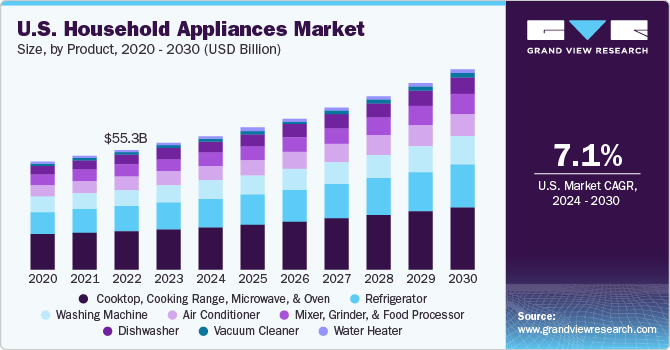
 U.S. household appliances market size, by product, 2020 - 2030 (USD Billion)

Other factors contributing to the growth of the U.S. market include the popularity of multi-functional and advanced products, which are capable of addressing more than one household application, thus giving good value for money. Vendors continually innovate to stay competitive, enhance customer satisfaction, expand the customer base, and generate demand for multi-functional household appliances to respond to the growing demand.

U.S. Household Appliances Market Segmentation

Grand View Research has segmented the U.S. household appliances market on the basis of product and distribution channel:

Based on the Product Insights, the market is segmented into Water Heater, Dishwasher, Refrigerator, Cooktop, Cooking Range, Microwave, and Oven, Vacuum Cleaner, Mixer, Grinder, and Food Processor, Washing Machine, and Air Conditioner

  • The air conditioner segment is anticipated to expand at a CAGR of 7.3% from 2022 to 2030. Rising temperatures and growing middle-class income levels are expected to propel the air conditioner segment growth during the projected period.
  • The cooktop, cooking range, microwave, and oven segment held the largest revenue share of over 30.0% in 2021.
  • Furthermore, increased disposable income and improved living standards are some of the other factors that would drive the demand for cooktops, cooking ranges, microwaves, and ovens in the U.S. during the forecast period.
  • The real estate market in the U.S. is expected to observe growth in demand for kitchen appliances owing to the desire to save time and effort.

Based on the Distribution Channel Insights, the market is segmented into Brick & Mortar and E-commerce

  • The brick and mortar segment held the largest revenue share of over 65.0% in 2021. Most consumers prefer brick-and-mortar stores for buying household appliances due to the exclusive offerings by product specialists and after-sale services.
  • The e-commerce segment is projected to register the fastest CAGR of 7.3% from 2022 to 2030.
  • Rising internet penetration amongst consumers and target marketing done by companies to reach all customer touchpoints are likely to fuel the growth of this segment.
  • The rapid expansion of e-commerce, along with the growing digitalization, especially among the young and millennial population at a global level, is driving the online sales of household appliances in the U.S.
  • Additionally, easy payment transactions and the busy lifestyles of consumers are driving the online sales of the products.

Key Companies Profile & Market Share Insights

The market includes both international and domestic participants. Key market players focus on strategies such as innovation and new product launches to enhance their portfolio offering in the market. For instance, in February 2021, Wolf Appliance, Inc. launched four new innovations such as the Wolf induction range, wolf dual fuel range, Wolf E-series built-in Ovens, and under-counter refrigeration in a virtual showcase.

Some prominent players in the U.S. Household Appliances market include:

  • Dongbu Daewoo Electronics
  • Electrolux
  • Fisher & Paykel Appliances Holdings Ltd.
  • Frigidaire
  • GE Appliances
  • Haier Group Corporation
  • LG Electronics
  • Panasonic Corporation
  • Philips Electronics
  • Robert Bosch GmbH
  • SAMSUNG
  • SMEG
  • Whirlpool Corporation

Order a free sample PDF of the U.S. Household Appliances Market Intelligence Study, published by Grand View Research.
India Consumer Electronics Market Growth Drivers, Vendor Landscape and Raw Material Outlook by 2030

India Consumer Electronics Industry Overview

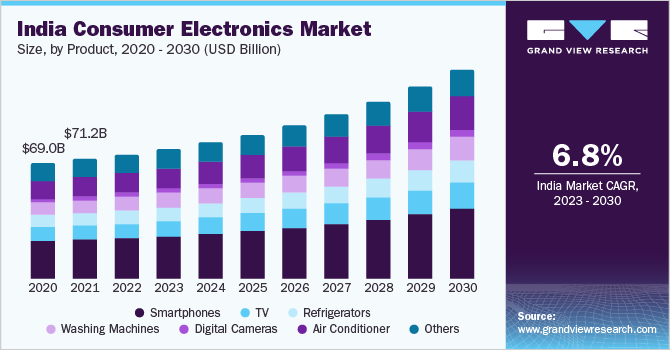
The India consumer electronics market size is expected to reach USD 124.94 billion by 2030, according to a new report by Grand View Research, Inc. It is expected to expand at a CAGR of 6.5% from 2022 to 2030. Rising disposable income, rapid urbanization, and the introduction of novel products in the market are expected to further contribute to the market growth.

India Consumer Electronics market revenue, by product 2020 - 2030 (USD Billion)

The demand for flat refrigerators, washing machines, and TVs is rising with a decline in penetration of products vis-à-vis global levels, urbanization, and increasing disposable income of consumers. There has been an increase in imports from regions such as China and South-East Asia, considered to be low-cost regions, owing to certain free-trade agreements and the availability of low-cost products, in relation to costs about local manufacturing. To effectively suffice the rising local demand and export demand to the neighboring regions and the Middle East and Africa, global market participants are planning to expand their local manufacturing in India, thus making it an export hub.

Under the Union Budget for the financial year 2017, the government exempted certain components, parts, and subparts for the production of set-top boxes for TV and internet and broadband modems. The introduction of artificial intelligence (AI) is set to project a bright future for consumers and industrial electronics in India.

India Consumer Electronics Market Segmentation

Grand View Research has segmented India consumer electronics market on the basis of product:

Based on the Product Insights, the market is segmented into Smartphones, Televisions, Refrigerators, Washing Machines, Digital Cameras, Air Conditioners, and Others

  • The smartphones segment held the largest revenue share of over 30.0% in 2021. Increased disposable income, the development of telecom infrastructure, the appearance of budget-friendly smartphones, and a rising number of product launches are all contributing to the smartphone market's rise in India.
  • In addition, the desire for high-speed data connectivity for integrated IoT (Internet of Things) applications like energy management and smart home devices is expected to drive 5G smartphone adoption.
  • The refrigerators segment is projected to grow from 2022 to 2030. Rapid urbanization, coupled with the increasing disposable income in the country, has contributed to a rise in demand for refrigerators.
  • Due to the versatile and advanced refrigerators available in the market, Indian consumers are replacing their existing and old refrigerators with new ones.
  • In addition to this scenario, refrigerator selling retailers are adopting competitive strategies such as teaming up with financial institutes to provide easy financing options to sell their products. Such trends are expected to favor the market growth over the forecast period.

Key Companies Profile & Market Share Insights

The market includes both international and domestic participants. Key market players focus on strategies such as innovation and new product launches to enhance their portfolio offering in the market. In December 2021, the first-ever Bespoke French Door refrigerator, Bespoke kitchen package, Bespoke JetTM vacuum cleaner, and Bespoke Washer and Dryer were displayed at Samsung's CES 2022 booth.

In October 2021, Panasonic Corporation, a leading diversified technology business in India, has announced the addition of 43 new refrigerator models and 24 new washing machine models to its home appliance lineup ahead of the festive season. In January 2021, In India, Toshiba's Home Appliance Business has opened its first unique store. The Toshiba Lifestyle Centre, which opened in Bangalore, is expected to provide first-hand experience with Toshiba's home appliance portfolio, which includes refrigerators, washing machines, dishwashers, water purifiers, and air purifiers.

Some prominent players in the India Consumer Electronics market include:

  • Samsung Electronics Co., Ltd.
  • LG Electronics, Inc.
  • Godrej Appliances
  • Sony Corporation
  • Mitsubishi Electric Corporation
  • Vijay Sales
  • Panasonic Corporation
  • Haier Consumer Electronics Group
  • Bajaj Electricals Ltd.
  • Hitachi Ltd.
  • Toshiba Corporation
  • Whirlpool Corporation

Order a free sample PDF of the India Consumer Electronics Market Intelligence Study, published by Grand View Research.
Real Estate Market Property Outlook, Impact of COVID-19 and Share Insights by 2030

Real Estate Industry Overview

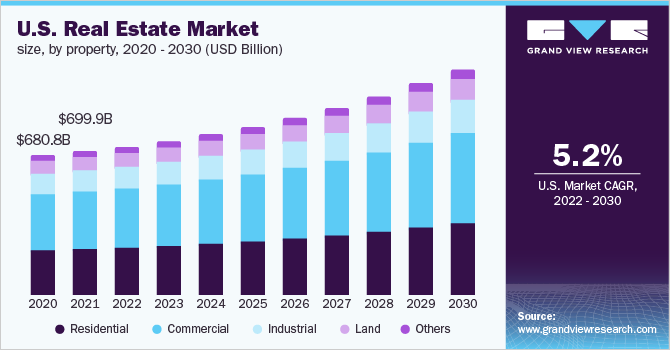
The global real estate market size is expected to reach USD 5.85 trillion by 2030, registering a CAGR of 5.2% from 2022 to 2030, according to a new report by Grand View Research, Inc. Rapid economic expansion in developing countries such as India, China, and several African countries has increased income levels and favored the real estate industry.

 U.S. real estate market size, by property, 2020 - 2030 (USD Billion)

Property and condominiums are purchased, sold, rented, and leased in the market for business and personal household usage. Due to an expanded number of significant companies joining the area regional market, the commercial real estate business has risen dramatically in the recent decade. Government reforms, reduced rentals, and lower mortgage rates in developing countries are expected to increase industry growth in the foreseeable future.

Real Estate Market Segmentation

Grand View Research has segmented the global real estate market based on property, type, and region:

Based on the Property Insights, the market is segmented into Residential, Commercial, Industrial, Land, and Others

  • Residential property dominated the market with a revenue share of 35.5% in 2021. The growth is majorly driven by the millennials as they are more inclined toward homeownership in recent years.
  • Commercial property is projected to register a CAGR of 5.1% from 2022 to 2030. The market is booming at an exceptional pace as a result of the growth of the tourism sector.
  • Moreover, the growing number of hotels and resorts is expected to drive the demand for bathroom furniture.

Based on the Type Insights, the market is segmented into Sales, Rental, and Lease

  • In terms of revenue, the rental type dominated the market with a share of 52.1% in 2021. This is attributable to rising home prices in developed countries, owing to which there is a rise in the number of renters, favoring the segment growth.
  • Sales type is estimated to expand at a CAGR of 6.1% over the forecast period. The COVID-19 pandemic has changed consumer perception towards owning a property, as result, there has been a rise in demand for luxury homes, villas, and second homes.

Real Estate Regional Outlook

  • North America
  • Europe
  • Asia Pacific
  • Central & South America
  • Middle East & Africa (MEA)

Key Companies Profile & Market Share Insights

The market is characterized by the presence of a few established players and new entrants. Many big players are increasing their focus on the growing trend of real estate. Players in the market are diversifying the service offering to maintain their market share.

Some prominent players in the global Real Estate market include:

  • Brookfield Asset Management Inc.
  • ATC IP LLC.
  • Prologis, Inc.
  • SIMON PROPERTY GROUP, L.P.
  • Coldwell Banker
  • RE/MAX, LLC.
  • Keller Williams Realty, Inc.
  • CBRE Group, Inc.
  • Sotheby’s International Realty Affiliates LLC.
  • Colliers

Order a free sample PDF of the Real Estate Market Intelligence Study, published by Grand View Research.
Movie and Entertainment Market Business Drivers, Prominent Companies and Impact of COVID-19

Movie and Entertainment Industry Overview

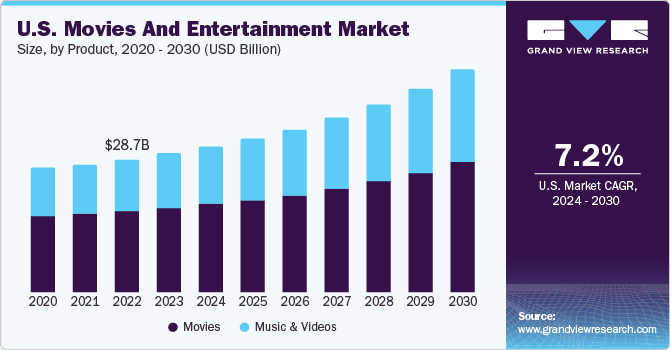
The global movies and entertainment market is expected to reach USD 169.6 billion by 2030, expanding at a CAGR of 7.2% from 2022 to 2030, according to a new report by Grand View Research, Inc. A rapid increase in the popularity of streaming of music, movies, and television series platforms is propelling the movies & entertainment market.

U.S. movies and entertainment market size, by product, 2020 - 2030 (USD Billion)

Moreover, most countries affected by COVID-19 have declared lockdowns to contain the spread of the virus. This increased the number of users who engaged in OTT platforms such as Amazon, Netflix, and Spotify. According to the China-based Tencent Music Entertainment (TME) group, the year-over-year revenue from online music subscriptions increased by 70.0% in the first quarter of 2020. Additionally, the number of online music paying users touched 42.7 million, a year-over-year rise of nearly 50.0%.

Movie and Entertainment Market Segmentation

Grand View Research has segmented the global movies and entertainment market on the basis of product and region:

Based on the Product Insights, the market is segmented into Movies and Music & Videos

  • In terms of revenue, movies dominated the market with a share of 55.4% in 2021. Over decades’ movies have become a significant part of most cultures across the world.
  • The prominent place of cinema in people’s life has made its primary means of entertainment in most countries.
  • Moreover, developments in technology, acceleration in production, improved quality, and better storage solutions, are driving the growth of the movies segment.
  • Music & videos is estimated to register a CAGR of 7.5% during the forecast period. Change in operational strategies of music companies such as a partnership with online streaming service providers and radio broadcast companies is attributive to this positive growth.
  • Additionally, the growing popularity of digital platforms and the increasing adoption of smart devices will contribute positively to industry growth over the forecast period.
  • Music streaming platforms such as Gaana, JioSaavn, Spotify, Wynk Music, Google Play Music, and Apple Music are increasingly getting popular among consumers and favoring the growth of the music & video segment.

Movie and Entertainment Regional Outlook

  • North America
  • Europe
  • Asia Pacific
  • Central & South America
  • Middle East & Africa (MEA)

Key Companies Profile & Market Share Insights

The market is characterized by the presence of a few established players and new entrants. Many big players are increasing their focus on the emerging trend of movies & entertainment. Players in the market are diversifying the service offering in order to maintain market share.

Some prominent players in the global Movie and Entertainment market include:

  • CBA Corporation and CBS Broadcasting Inc.
  • Sony Entertainment, Inc.
  • The Walt Disney Company
  • Time Warner
  • 21st Century Fox
  • Viacom Inc.
  • Comcast
  • Netflix, Inc.
  • Vivendi
  • Universal Pictures

Order a free sample PDF of the Movie and Entertainment Market Intelligence Study, published by Grand View Research.

Germany Consumer Appliances Market Analysis Report by Product, Application and Demand

Germany Consumer Appliances Industry Overview

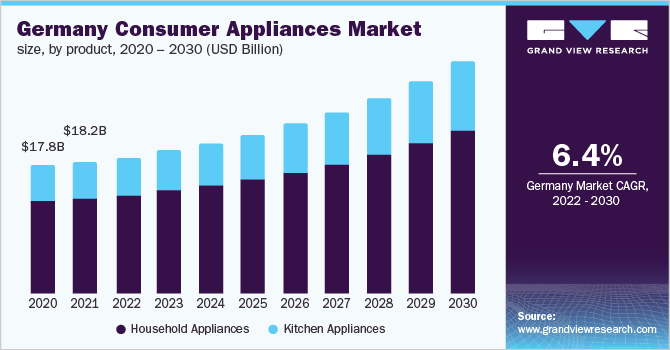
The Germany consumer appliances market size is expected to reach USD 31.86 billion by 2030, according to a new report by Grand View Research, Inc. The market is expected to expand at a CAGR of 6.4% from 2022 to 2030. Germany is considered a mature and developed market in the consumer appliances industry. Germany has been the focal point of development in the European region in terms of innovation and considering the requirements of the consumers.

Germany Consumer Appliances Market size, by product, 2020 - 2030 (USD Billion)

The sales of household appliances in the German market depend upon the trade deals for the remodeling and renovation of houses or exchange and upgradation of older household appliances. The technical and mechanical advancements in home appliances products have contributed towards enhancing the way of life of individuals in Germany. A wave of change in the use of these products can be seen because of the increasing disposable income of German citizens and the fast urbanization patterns occurring in different parts of the world.

Germany Consumer Appliances Market Segmentation

Grand View Research has segmented the Germany consumer appliances market based on product and distribution channel:

Based on the Product Insights, the market is segmented into Household Appliances and Kitchen Appliances

  • Household appliances held the largest revenue share of more than 70.0% in 2021.
  • The most prominent products in the domestic household appliance industry are refrigerators, freezers, washing machines, air conditioners, vacuum cleaners, and dryers to name a few. These products are also known as white goods.
  • Major household appliances have high demand in the market. Now with the increasing demand for major appliances, there is a growing demand for smart appliances coming into the picture as well.
  • Consumers have now started utilizing modern and technically advanced devices and appliances due to the associated convenience and time-saving. There is a steady growth predicted in this segment for Germany.
  • The factors responsible for this growth could be due to the improving lifestyles of consumers, improvement in the purchasing power, and migration of the rural population to the urban areas.

Based on the Distribution Channel Insights, the market is segmented into E-retailers, Discount, Variety Stores and General Merchandisers, Hypermarket, Supermarket and Discounters, Department Stores, and Others

  • The e-retailers segment held the largest revenue share of over 45.0% in 2021. In Germany, there is a greater degree of concentration as large retailers like Metro (Media Markt and Saturn) hold large market shares, thus acting as a greater deterrent to new entrants.
  • E-commerce is booming in the German market with Amazon and Otto being the top e-retailers in the market space.
  • E-retailers are followed by departmental stores, which is the second-highest growing distribution channel in Germany.
  • The German population has demonstrated an inclination towards retail offers and discounts, along with a high number of secured e-payment options. Thus, the German e-retail and departmental stores are expected to witness high growth during the forecast years.

Key Companies Profile & Market Share Insights

The market has been characterized by the presence of international and domestic participants. Key market players focus on strategies such as innovation and new product launches to enhance their portfolio offering in the market. For instance, in September 2021, BSH Appliances launched the new model of their pioneering Bosch Smart Indoor Gardening solutions. Additionally, in August 2021, Bosch Appliances lined up product launches across the world. The company plans to launch over 25 models of chimneys and hoods with premium features, such as auto cleaning, and various models of cooking and gas top burners.

Some prominent players in the Germany Consumer Appliances market include:

  • Panasonic Corporation
  • BSH Hausegrate GmbH
  • Electrolux Group
  • Gorenje
  • Arcelik A.S.
  • Bosch
  • Miele
  • Thermador
  • Gaggenau
  • Liebherr

Order a free sample PDF of the Germany Consumer Appliances Market Intelligence Study, published by Grand View Research.

U.S. Hotels, Resorts and Cruise Lines Market is registering a CAGR of 9.3% by 2030

U.S. Hotels, Resorts and Cruise Lines Industry Overview

The U.S. hotels, resorts, and cruise lines market size is expected to reach USD 488.1 billion by 2030, registering a CAGR of 9.3%, according to a new report published by Grand View Research, Inc. The demand for hotels and resorts varies by property type and is influenced by factors such as location, size, and on-site amenities.

 U.S. Hotels, Resorts And Cruise Lines Market size, by type, 2020 - 2030 (USD Billion)

The market is likely to be driven by rising disposable income, the popularization of weekend culture, the introduction of low-cost airline services, and the developing service industry. Some of the primary factors responsible for drawing clients to hotels and resorts include inflation in spending power and style of living. Furthermore, the rise of digital innovation aided in the recording of this rising number, as well as the ability of players who manage shared spaces, such as Airbnb, to reach out to their target audience.

U.S. Hotels, Resorts and Cruise Lines Market Segmentation

Grand View Research has segmented the U.S. Hotels, Resorts, And Cruise Lines market based on type:

Based on the Type Insights, the market is segmented into Hotel, Resorts, and Cruise

  • The hotel segment of the U.S. hotels, resorts, and cruise lines market accounted for the largest revenue share of around 90% in 2021.
  • The COVID-19 pandemic has presented an excellent opportunity for the hotel industry to engage in innovative contactless technology solutions, given all of the current obstacles and constraints.
  • Customers have shown a strong interest in technology such as contactless payments, digital messaging, self-service check-in, and smartphone-activated room keys in recent years, in addition to online booking systems.
  • The cruise companies stated they were expecting pent-up demand in the second quarter of 2021, but that demand dropped down after a few months. Several businesses have incurred significant costs as a result of the pandemic, causing them to reduce their occupancy and employees.

Key Companies Profile & Market Share Insights

The market includes both international and domestic participants. Key market players focus on strategies such as innovation and new product launches to enhance their portfolio offering in the market. In July 2021, Carnival Corp announced that their new ship, the Mardi Gras, would set sail from Port Canaveral to the eastern and western Caribbean. The ship is the first in the world to feature a rollercoaster on board, as well as the first in North America to be fueled by liquefied natural gas, according to Carnival Corp.

Some prominent players in the U.S. Hotels, Resorts and Cruise Lines market include:

  • Marriott International, Inc.
  • Wyndham Hotel Group, LLC.
  • Hilton
  • Choice Hotels International, Inc.
  • IHG
  • Best Western Hotels & Resorts.
  • G6 Hospitality LLC.
  • American Cruise Lines
  • Carnival Corp
  • AIDA Cruises

Order a free sample PDF of the U.S. Hotels, Resorts and Cruise Lines Market Intelligence Study, published by Grand View Research.
Railroads Market Growth Drivers, Vendor Landscape and Raw Material Outlook by 2030

Railroads Industry Overview

The global railroads market size is expected to reach USD 436.4 billion by 2030, exhibiting a CAGR of 4.4% during the forecast period, according to a new report by Grand View Research, Inc. Increased government investments in various countries to enhance railway infrastructure and create new lines, as well as the growing tourism industry in Asia Pacific and European countries, are important factors driving market expansion. Moreover, growing industrialization in underdeveloped and developing countries is likely to drive railroad demand throughout the forecast period.

U.S. railroads market size, by type, 2020 – 2030 (USD Billion)

The rail freight segment is predicted to grow significantly throughout the forecast period, owing to a growing reliance on rail routes for the transportation of goods and lower rail freight rates. Furthermore, a strong rail network facilitates the transportation of commodities to isolated places that are otherwise impossible to reach by air. The availability of less expensive alternatives for transporting large products or shipments is likely to boost rail freight demand in the coming years.

Railroads Market Segmentation

Grand View Research has segmented the global railroads market based on type, end use, and region:

Based on the Type Insights, the market is segmented into Rail Freight and Passenger Rail

  • The passenger rail segment led the market with a share of 58.7% of the global revenue in 2021. The segment is projected to witness growth over the coming years as the tourism industry picks up speed thanks to inexpensive passenger train fares.
  • Furthermore, increased investments in the expansion of passenger railroad networks and the introduction of newer and faster trains, like bullet trains and metros, are likely to propel segment growth.
  • The rail freight segment has been witnessing steady growth owing to the growing reliance on railroad routes for the transportation of goods and lower rail freight rates.

Based on the End-use Insights, the market is segmented into Mining, Construction, Agriculture, and Others

  • The agriculture segment held the largest share of 34.2% in the railroad market in terms of revenue in 2021. Stable and efficient railroad service is especially crucial for the agriculture industry.
  • The mining segment is expected to register the fastest CAGR over the forecast period to overtake the agriculture segment in terms of market size by 2030.
  • Monorail systems are being increasingly employed in coal and ore mines because of their efficiency and cheap running costs.

Railroads Regional Outlook

  • North America
  • Europe
  • Asia Pacific
  • Middle East & Africa (MEA)

Key Companies Profile & Market Share Insights

The market includes both international and domestic participants who focus on strategies such as innovation, mergers and acquisitions, and investments in technology, infrastructure, and expansions to enhance their position in the market.

Some prominent players in the global Railroads market include:

  • Central Japan Railway Company
  • SNCF Group
  • Union Pacific Corporation
  • OAO RZD (Russian Railways)
  • BNSF Railway
  • Indian Railways
  • Deutsche Bahn
  • JSC Russian Railways
  • CSX Corporation

Order a free sample PDF of the Railroads Market Intelligence Study, published by Grand View Research.
What is The Fruit and Vegetable Juice Market Growth?

Fruit and Vegetable Juice Industry Overview

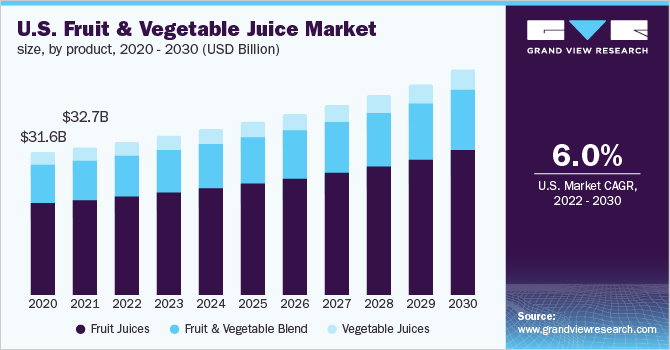
The global fruit and vegetable juice market size is expected to reach USD 228.96 billion by 2030, registering a CAGR of 6.3% over the forecast period, according to a new report by Grand View Research, Inc. Some of the key factors driving the market are the increasing consumption of fruit juices, the introduction of fruit and vegetable blends, and rising disposable income in emerging countries. The adoption of healthier lifestyles and the advent of cold-pressed juices is propelling market potential in the upcoming years. The consumption of soft drinks, such as non-alcoholic beverages, cola, flavored sodas, and other sugar-sweetened beverages, is seen to be reducing globally.

U.S. fruit and vegetable juice market size, by product, 2020 - 2030 (USD Billion)

These drinks have no nutritional value in sharp contrast to fruit and vegetable juices available on the market. High sugar, fructose corn syrup, phosphoric acid, artificial sweeteners, and caffeine content are some of the main ingredients in such drinks that culminate in a wide range of diseases. In terms of product, the fruit juices segment led the market in 2021. Consumers have become more aware of the harmful health effects associated with the consumption of sugary carbonated drinks. In addition to this, the growing focus on healthy lifestyles among the young, as well as working-class populations across the globe is increasing the scope for natural fruit-based beverages.

Fruit and Vegetable Juice Market Segmentation

Grand View Research has segmented the global fruit and vegetable juice market on the basis of product, distribution channel, and region:

Based on the Product Insights, the market is segmented into Fruit Juices, Fruit & Vegetable Blend, and Vegetable Juices

  • The fruit juices segment led the market in 2021 and accounted for the largest share of 61.2% of the global revenue. The segment is expected to maintain its dominance even during the forecast period.
  • The increasing preference for high vitamin and mineral content beverages is expected to fuel the segment growth over the forecast period.
  • The vegetable juice segment is projected to register the fastest CAGR from 2022 to 2030.

Based on the Distribution Channel Insights, the market is segmented into Supermarkets/Hypermarkets, Convenience Stores, Online, and Others

  • The supermarkets/hypermarkets segment led the market and accounted for the largest revenue share of around 55.9% of the global revenue in 2021.
  • The ability to physically verify these products and expert assistance by sales representatives are also among the major factors contributing to the segment growth.
  • The online distribution channel segment is anticipated to register the fastest CAGR from 2022 to 2030. The online segment witnessed significant growth throughout 2020, given the temporary and permanent closures of physical distribution channels in the region.

Fruit and Vegetable Juice Regional Outlook

  • North America
  • Europe
  • Asia Pacific
  • Central & South America
  • Middle East & Africa (MEA)

Key Companies Profile & Market Share Insights

Major market players face intense competition from local players in every geographic region. The existence of small-scale players who sell their products at slightly lesser prices causes the market to be highly fragmented. The only advantage key players possess is the maturity in an industry and a controlled grip over product life cycles. As these larger players attain scale of economies, production of large-scale units is easy and manageable giving them an upper hand. In November 2021, Dole Sunshine India launched its 100% natural pineapple juice with pure fruity goodness. The new beverage is manufactured with natural pineapple, enriched with vitamin C and no added sugars and preservatives.

Some prominent players in the global Fruit and Vegetable Juice market include:

  • The Coca-Cola Company
  • PepsiCo Inc.
  • Fresh Del Monte Produce Inc.
  • Pepper Snapple Group
  • Hershey
  • Grimmway Farms
  • Welch Food Inc.
  • Ocean Spray
  • Golden Circle
  • Dole Packaged Foods, LLC

Order a free sample PDF of the Fruit and Vegetable Juice Market Intelligence Study, published by Grand View Research.
Ice Cream Market Size, Share and Trends Analysis Report by Type, 2030

Ice Cream Industry Overview

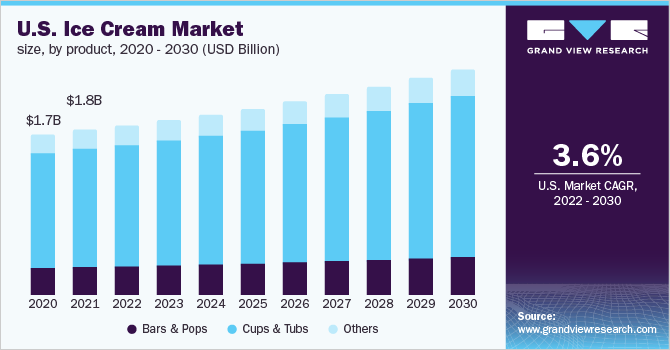
The global ice cream market size is expected to reach USD 114.7 billion by 2030, according to a new report by Grand View Research, Inc. The market is projected to expand at a CAGR of 4.2% from 2022 to 2030. The growth is attributed to the rising demand for premium ice cream products. The manufacturers in the foodservice sector are incorporating a variety of ice cream flavors and products into their menus to cater to a larger customer base. This trend is anticipated to further fuel the growth of the market.

U.S. ice cream market size, by product, 2020 - 2030 (USD Billion)

The demand for lactose-free ice cream is also expected to contribute to market growth during the forecast period. The market is driven by an increase in the cases of food intolerances and allergies. Consumers suffering from lactose intolerance prefer vegan and dairy-free ice creams. Health-conscious consumers also prefer these variants to meet their demand for healthy foods.

Ice Cream Market Segmentation

Grand View Research has segmented the global ice cream market based on product, type, flavor, distribution channel, and region:

Based on the Product Insights, the market is segmented into Bars & Pops, Cups & Tubs, and Others

  • The cups & tubs segment held the largest revenue share of over 73.0% in 2021. The segment is projected to register a CAGR of 4.0% during the forecast period.
  • The growing preference for ice cream as a daily post-meal dessert is expected to fuel the product demand.
  • The bars & pops segment is expected to register the second-fastest growth of over 3.0% during the forecast period.
  • The increasing product innovations and the rising consumer for convenient product options are the factors expected to fuel the demand for bars & pops.

Based on the Type Insights, the market is segmented into Dairy & Water-based and Vegan

  • The dairy & water-based segment accounted for the largest revenue share of over 95.0% in 2021 and is expected to maintain dominance during the forecast period.
  • With the rapidly growing urbanization and advancement in technology in the European dairy sector, the demand for luxury ice cream and daily ice cream desserts products continues to rise steeply in Europe.
  • The utilization of novel ingredients like whole milk, skim milk, and sweetening & flavoring agent is the main factor driving the annual revenue of the Europe market.
  • The vegan segment is projected to exhibit the fastest CAGR of over 9.0% from 2022 to 2030.
  • A rise in food allergies and the increasing popularity of veganism are the factors expected to drive the demand for vegan products and thereby contribute to the growth of the segment.

Based on the Flavor Insights, the market is segmented into Chocolate, Vanilla, Fruit, and Others

  • The vanilla flavor segment held the second-largest revenue share of over 28.0% in 2021. The vanilla flavor is one of the most popular flavors around the world.
  • The ability of vanilla flavor to blend with most desserts and enhance the taste is expected to contribute to the demand.
  • The others segment is anticipated to register the fastest CAGR of 5.0% from 2022 to 2030. The increasing preference for innovative and different flavors is expected to fuel the demand for the other flavors in the ice cream market.

Based on the Distribution Channel Insights, the market is segmented into Foodservice and Retail

  • The retail segment held the largest revenue share of more than 74.4% in 2021 and is expected to maintain dominance over the forecast period.
  • The growing popularity of sundaes, as well as a diverse range of flavors and availability of a wide variety of products in the retail stores, is expected to drive sales through this channel.
  • The foodservice distribution channel is expected to register the second-fastest CAGR of 3.9% from 2022 to 2030.

Ice Cream Regional Outlook

  • North America
  • Europe
  • Asia Pacific
  • Central & South America
  • Middle East & Africa (MEA)

Key Companies Profile & Market Share Insights

Numerous small and mid-size players operating in various countries contribute to the overall growth of the market. The manufacturers are introducing new flavors and formats to enhance their sales volume which has been decreasing especially in developed regions such as North America and Western Europe. Nowadays, ice creams with natural ingredients, low calories, and health claims appeal the most to consumers, thus, manufacturers are focused on launching products with these attributes.

Some prominent players in the global Ice Cream market include:

  • Unilever
  • Inspire Brands, Inc.
  • General Mills, Inc.
  • Kwality Wall’s
  • American Dairy Queen Corporation
  • Nestlé
  • Blue Bell Creameries
  • Cold Stone Creamery
  • Danone S.A.
  • NadaMoo

Order a free sample PDF of the Ice Cream Market Intelligence Study, published by Grand View Research.
Chocolate Confectionery Market Top Players are Chocoladefabriken Lindt and Sprüngli AG and Ferrero

Chocolate Confectionery Industry Overview

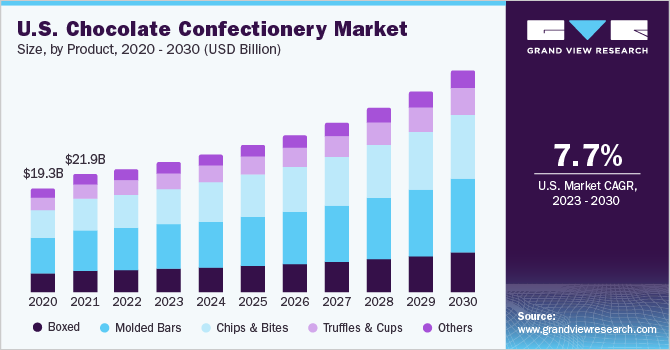
The global chocolate confectionery market size is expected to reach USD 312.6 billion by 2030, expanding at a CAGR of 6.4% during the forecast period, according to a new report by Grand View Research, Inc. The chocolate confectionery market growth is attributed to the increasing tradition of gifting chocolates, especially in Asian countries.

 U.S. chocolate confectionery market size, by product 2020 - 2030 (USD Billion)

Manufacturers are launching a wide range of chocolate confectionery in the healthier segment, with claims such as vegan, gluten, and dairy-free to cater to the rising customer demand, which is increasing the scope of chocolate confectionery in the global market. For instance, in September 2020, Chocoladefabriken Lindt & Sprüngli AG inaugurated the Lindt Home of Chocolate in Switzerland. The facility showcases a unique chocolate competence center, attractive museum, and open-view production plant. Further, strong advertising and marketing campaigns for vegan, low-sugar, and gluten-free chocolates are also driving the demand.

Chocolate Confectionery Market Segmentation

Grand View Research has segmented the chocolate confectionery market based on product, type, distribution channel, and region.

Based on the Type Insights, the market is segmented into Milk, Dark, and White

  • Milk type was the largest segment in 2021. With a rising preference for milk type category, many companies have been launching new products with clean labels such as organic, vegan, and certified Kosher to expand the existing product portfolio.
  • However, the dark type segment is projected to register the highest growth during the forecast period.
  • In the past few years, the popularity of the product among consumers, especially in Asian countries, has increased with shifting taste preferences and growing awareness about the many health benefits of dark chocolate.

Based on the Product Insights, the market is segmented into Boxed, Molded Bars, Chips & Bites, Truffles & Cups, and Others

  • Molded bars segment held the largest market share in 2021 and is expected to maintain its dominance during the forecast period.
  • Bar chocolates are the most consumed chocolate form in the world. They are popular among consumers owing to their convenient size. Product launches in this segment by key players are driving the segment growth.
  • The chips & bites segment is projected to register the fastest growth from 2022 to 2030. With the rising demand for premium products for various festivals and small occasions, the demand for chips & bites is also rising.

Based on the Distribution Channel Insights, the market is segmented into Supermarkets & Hypermarkets, Convenience Stores, Online, and Others

  • Supermarkets & hypermarkets distribution channels made the largest contribution to the global market in 2021.
  • The segment is projected to retain its dominance throughout the forecast period, owing to the high consumer inclination toward shopping for grocery products from supermarkets.
  • The online distribution channel is anticipated to be the fastest-growing segment during the forecast period.
  • The shift in consumers’ shopping behavior is one of the major factors driving product sales through online channels.
  • Growing consumer preference for online platforms has prompted companies to offer products through this channel.

Chocolate Confectionery Regional Outlook

  • North America
  • Europe
  • Asia Pacific
  • Central & South America
  • Middle East & Africa (MEA)

Key Companies Profile & Market Share Insights

The market is competitive, owing to the presence of many global and domestic companies. Various strategies, such as introducing innovative product offerings into the market and marketing & promotions, are being adopted by these key market players to increase the outreach of their products and expand their presence into emerging markets.

Some prominent players in the global Chocolate Confectionery market include:

  • The Hershey Company
  • Ferrero
  • Chocoladefabriken Lindt & Sprüngli AG
  • Mars, Incorporated
  • MondelÄ“z International
  • Nestlé
  • CEMOI Group
  • Barry Callebaut
  • Lake Champlain Chocolates
  • LOTTE

Order a free sample PDF of the Chocolate Confectionery Market Intelligence Study, published by Grand View Research.
Global Books Market size is expected to reach USD 164.22 Billion by 2030

Books Industry Overview

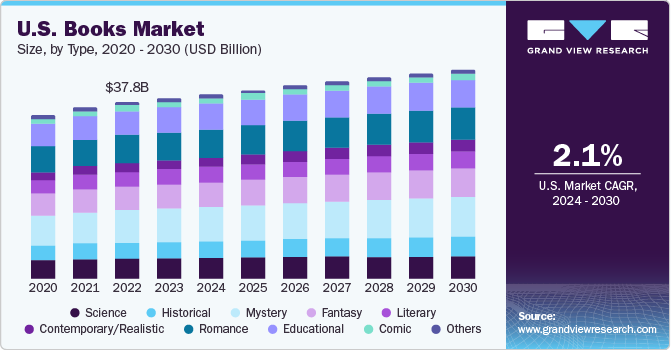
The global books market size is expected to reach USD 164.22 billion by 2030, expanding at a CAGR of 1.9% during the forecast period, according to a new report by Grand View Research, Inc. Increasing consumer expenditure on books, fueled by rising incomes and interest, as well as ongoing format improvements that have improved the entire reading experience, are among the primary reasons driving the book business forward. Independent publishers have been on a rise in the recent past. According to Linchpin SEO, there were approximately 69,709 independent publishers in the book industry as of 2020. In response to the apparent monopoly in traditional publishing, excluded individuals have turned to independent publishers not associated with large publishing houses.

U.S. books market size, by type, 2020 – 2030 (USD Billion)

While traditional publishing companies seek to corner the market, independent publishers provide an opportunity for diversity and inclusion among authors and niches. These publishers are smaller and, in some cases, completely digital and that is the key behind their numbers increasing year on year. Along with this, most large publishers are privately owned. So, it is difficult to assess the number of books being sold globally and the revenue that is generated from it.

Books Market Segmentation

Grand View Research has segmented the global books market based on type, format, distribution channel, and region:

Based on the Type Insights, the market is segmented into Science, Historical, Mystery, Fantasy, Literary, Contemporary/Realistic, Romance, Educational, Comic, and Others

  • Science segment is anticipated to expand at a CAGR of 1.8% from 2022 to 2030. Science books are usually a work of non-fiction and could be related to a science or non-science-based person.
  • Female scientists and science writers such as Rachel Carson and Jane Goodall have also had a significant impact on their respective fields and through their writing.
  • The Mystery segment led the market and accounted for a 16.6% share of the global revenue in 2021. Readers often respond to books because they can relate to one of the characters.

Based on the Format Insights, the market is segmented into Facial Hard Copy, E-Books, and Audiobooks

  • Hard copy segment accounted for the largest market revenue share of around 78.7% in 2021. Despite an onslaught of new technology, books have proved to be extremely resilient.
  • The audiobook segment is anticipated to register faster growth during forecast years with a CAGR of 3.1% from 2022 to 2030.
  • Audiobooks are immersive, educational, instructional, and entertaining and they are perfect for the time-rich and the time-poor.
  • Audiobooks can also change the way people listen, read, and learn, improving the literacy of young readers and those for whom English is a second language.

Based on the Distribution Channel Insights, the market is segmented into Online, Local Book Shops, Retail Shops, Specialty Stores

  • Local book shops were the largest distribution channel with a market revenue share of around 50.3% in 2021.
  • A local bookstore offers a home to both authors and readers and is a welcoming place to come together to feel comfortable and at ease.
  • The online channel is anticipated to register faster growth during forecast years with a CAGR of 2.9% from 2022 to 2030.

Books Regional Outlook

  • North America
  • Europe
  • Asia Pacific
  • Central & South America
  • Middle East & Africa (MEA)

Key Companies Profile & Market Share Insights

The books market includes both international and domestic participants. Key market players focus on strategies such as innovation and new product launches in retail about products to enhance their portfolio offering in the market.

Some prominent players in the global Books market include:

  • Penguin Random House
  • Hachette Book Group
  • HarperCollins Publishers
  • Simon & Schuster, Inc.
  • Pearson
  • Macmillan Publishers
  • Scholastic Inc.
  • Marvel Comics
  • Morris Publishing
  • IDW Publishing

Order a free sample PDF of the Books Market Intelligence Study, published by Grand View Research.
North America Chocolate Market Segmentation and Growth Prospects Mapping

North America Chocolate Industry Overview

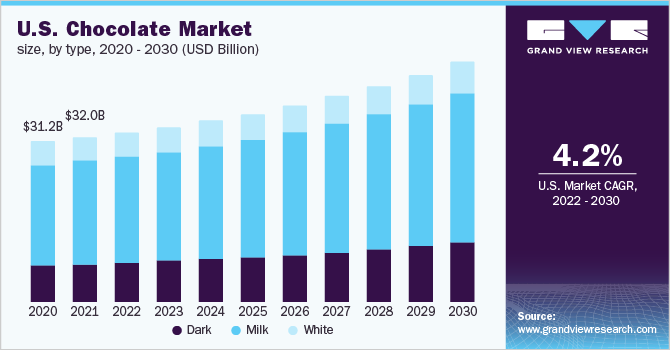
The North America chocolate market is expected to reach USD 57.4 billion by 2030, according to a new report by Grand View Research, Inc. It is expected to expand at a CAGR of 4.3% from 2022 to 2030. The health advantages of dark chocolate intake, together with rising demand for this product in a variety of applications such as confectionery and flavored eatables, are expected to drive the growth of North America chocolate market. Chocolate is becoming more popular as moderate consumption of chocolate increases serotonin, which soothes the brain and functions as an antidepressant. It also causes the release of endorphins in the body, which rapidly improves mood. This, in turn, is propelling market expansion.

U.S. chocolate market size, by type, 2020 - 2030 (USD Billion)

Rising demand from children as a result of enhanced marketing through social media and television commercial channels by confectionery firms is driving the market expansion. The growing popularity of chocolates as a token of love, appreciation, and happiness that are given as gifts during the holiday season, primarily attracts consumers. Further, packaging, ingredients, authenticity, and the are buying experience, is also expected to boost the chocolate demand. This, in turn, is propelling market expansion.

North America Chocolate Market Segmentation

Grand View Research has segmented the North America chocolate market based on type, distribution channel and country:

Based on the Type Insights, the market is segmented into Dark, Milk, and White

  • The milk segment led the market and accounted for a 62.2% share of the revenue in 2021. Milk chocolates have a low cocoa concentration and a high milk content, making them sweet and creamy with a refined taste.
  • Over the projected period, this is likely to emerge as a primary growth driver for the product. Growing demand for the product as an addition in frosting on cakes, cupcakes, puddings, and other sweets will also drive growth.
  • The dark segment is anticipated to expand at the fastest CAGR of 5.1% from 2022 to 2030. Dark chocolate's demand is predicted to rise as its application in the confectionery and bread industries expands.
  • Furthermore, the rising consumer desire for sugar-free and healthier baked products is likely to drive demand throughout the projection period.
  • Also, growing health advantages associated with cocoa-rich dark chocolates, increasing online sales, players launching more limited-edition chocolates, and expanding marketing strategies are expected to boost the worldwide dark chocolate market over the projected period.

Based on the Distribution Channel Insights, the market is segmented into Offline and Online

  • The offline segment made a larger contribution to the global market of over 61.1% in 2021.
  • The success and growing acceptance of premium chocolates, are driven by both consumers' desire to indulge in this "affordable luxury".
  • The influence of foodie culture, as well as the growth of chocolate retailers, both through franchise expansion and by successful independent shops looking to expand their footprints, are expected to drive the growth of chocolate sales in the offline distribution channel.

Key Companies Profile & Market Share Insights

The market includes both international and domestic participants. Key market players focus on strategies such as innovation and new product launches in retail about chocolate products to enhance their portfolio offering in the market.

Some prominent players in the North America Chocolate market include:

  • The Hershey Company
  • Mars Incorporated
  • Nestlé
  • Ferrero
  • Chocoladefabriken Lindt & Sprüngli AG
  • Godiva
  • Ghirardelli Chocolate Company
  • MondelÄ“z International
  • General Mills Inc.
  • Clif Bar & Company

Order a free sample PDF of the North America Chocolate Market Intelligence Study, published by Grand View Research.
Yogurt Drink Market Business Drivers, Prominent Companies and Impact of COVID-19

Yogurt Drink Industry Overview

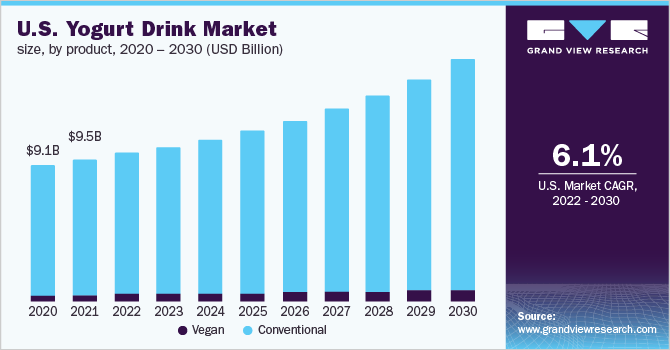
The global yogurt drink market is anticipated to reach USD 86.08 billion by 2030, registering a CAGR of 6.4% during the forecast period, according to a new report by Grand View Research, Inc. The growth of this market can be attributed to the rising incidence of lifestyle disorders and gut health concerns among millennials and the working population. The growing consumer preference for healthier snacking products has contributed significantly to the growth of this market in recent years. Yogurt drinks offer several advantages, such as improved gut health and immunity. The rising health consciousness among consumers has led to increased product demand.

U.S. Yogurt Drink Market size, by product, 2020-2030 (USD Billion)

Moreover, the advent of functional and fortified products in conventional market spaces has resulted in increased consumer awareness regarding healthy food habits; thus, market players are focusing on new product developments and flavor improvements to cater to the rising demand. These drinks are highly popular in western countries, especially in the U.S. According to the United States Department of Agriculture (USDA), yogurt provides important nutrients, including vitamins and calcium in adequate quantity. It is among the three popular healthy dairy products supported by the USDA besides cheese and fluid milk. The online distribution channel is expected to register the fastest CAGR during the forecast period.

Yogurt Drink Market Segmentation

Grand View Research has segmented the global yogurt drink market based on product, packaging, distribution channel, and region:

Based on the Product Insights, the market is segmented into Vegan and Conventional

  • The conventional products segment led the market in 2021 and accounted for the largest share of more than 93.5% of the global revenue. The segment is expected to maintain its dominance in the forecast period.
  • The rising cases of obesity are anticipated to be among the major growth-driving factors for the segment.
  • On the other hand, the vegan segment is projected to register the fastest CAGR during the forecast period.
  • The possible ability of vegan products to reduce cholesterol levels, which reduces the chances of digestion-related problems, is projected to fuel the growth of this segment during the forecast period.

Based on the Packaging Insights, the market is segmented into Bottles and Tetra Packs

  • The tetra packs packaging segment held the largest share of more than 88.00% of the global revenue in 2021 and is expected to maintain its dominance in the forecast period.
  • With significant changes in consumer lifestyles, a vast majority of consumers across the globe are opting for on-the-go products, which offer ease of consumption as well as waste disposal. This is expected to contribute to the segment growth during the forecast period.
  • However, bottles are projected to register the fastest CAGR during the forecast period. With a change in lifestyle, a large number of people across the globe are opting for on-the-go products, which, in turn, is projected to fuel the segment growth over the forecast period.
  • Furthermore, the availability of different sizes and shapes in accordance with consumer needs will support the segment growth.

Based on the Distribution Channel Insights, the market is segmented into Hypermarkets & Supermarkets, Convenience Stores, Online, and Others

  • The hypermarkets & supermarkets segment accounted for the largest share of 75.5% of the global revenue in 2021. An increasing number of these stores across various regions is the major growth-driving factor for the segment.
  • The expansion of modern retail chains in Asia Pacific countries, such as Thailand, Malaysia, Philippines, and Indonesia, will support the segment growth over the coming years.
  • The online distribution channel segment is anticipated to register the fastest CAGR during the forecast years. The segment is poised to emerge as a steady source of revenue over the forecast period.
  • Promising growth exhibited by e-commerce platforms in emerging countries, including India and China, is compelling manufacturers to reorient their retail strategies in these countries.

Yogurt Drink Regional Outlook

  • North America
  • Europe
  • Asia Pacific
  • Central & South America
  • Middle East & Africa (MEA)

Key Companies Profile & Market Share Insights

The market is extremely competitive due to the presence of global companies as well as small-scale companies with high manufacturing volumes. A large number of companies are involved in research and development to offer improved and better-quality yogurt drinks. Most companies are focusing on new product launches and innovations to attract more consumers.

Some prominent players in the global Yogurt Drink market include:

  • Danone
  • Nestlé
  • Yakult Honsha Co., Ltd.
  • General Mills Inc.
  • Meiji Holdings Co., Ltd.
  • Chobani, LLC
  • Fonterra Co-operative Group Ltd.
  • Arla Foods amba
  • Lactalis Group
  • Benecol Ltd.

Order a free sample PDF of the Yogurt Drink Market Intelligence Study, published by Grand View Research.

Canned Seafood Market Key Players are Maruha Nichiro Corporation and Icicle Seafoods Inc.

Canned Seafood Industry Overview

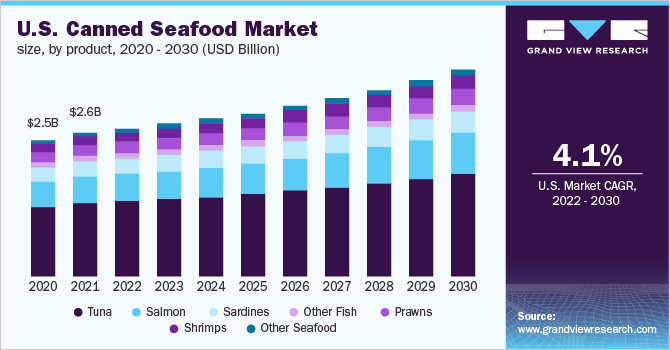
The global canned seafood market size is expected to reach USD 50.47 billion by 2030, expanding at a CAGR of 5.9%, according to a new report by Grand View Research, Inc. Increasing demand for essential fatty acids and proteins in consumer diets has contributed to the growth of canned seafood in the recent years. Moreover, the growing popularity of chemical-free packaged seafood with higher shelf life has promoted the adoption of canned seafood among consumers.

U.S. canned seafood market size, by product, 2020 - 2030 (USD billion)

Technological advancements in tuna fishing coupled with Fish Aggregating devices and advanced packaging technology for fish products are anticipated to drive the industry growth during the forecast period. In addition, improved packaging procedures with the use of RFID tags to improve product traceability and agglomeration are expected to increase product adoption by the consumers, thereby contributing to the market growth. For instance, in March 2021, Thai Union Frozen products SPACE-F announced FoodsTech Accelerator and Incubator Program that allow food processing at a faster pace and preserve the quality of its food.

Canned Seafood Market Segmentation

Grand View Research has segmented the canned seafood market based on product, distribution channel, and region:

Based on the Product Insights, the market is segmented into Tuna, Salmon, Sardines, Other Fish, Prawns, Shrimps, and Other Seafood

  • The tuna segment held the largest market share of 42.22% in 2021 and is expected to maintain dominance during the forecast period due to the predominant consumption of ready meals among working-class people around the globe.
  • Further, the segment is expected to grow on account of new product launches. For instance, in August 2021, Mind Fish Co. launched the first Fair Trade Certifiedä canned tuna product available for purchase in the North American market.
  • However, sardines are projected to register a CAGR of 7.8% from 2022 to 2030. As a portable snack, canned sardines have become more popular than fresh ones since they do not need to be cooked.

Based on the Distribution Channel Insights, the market is segmented into Foodservice and Retail

  • Retail was the largest distribution channel, with a market share of around 60.0% in the global revenue in 2021. This channel includes supermarkets, hypermarkets, convenience stores, grocery stores, and local shops.
  • The increasing number of these stores across various regions has experienced a surge in the distribution of canned seafood in the market.
  • According to an article published by Supermarket News, in February 2021, convenience stores are the main drivers of canned seafood, whereas the retail sector holds around 48% of the distribution market.
  • The foodservice distribution channel is anticipated to register faster growth during forecast years with a CAGR of 6.3% from 2022 to 2030.
  • The segment is poised to emerge as a steady source of revenue during the forecast period. Growth in consumption of canned seafood in restaurants and hotels is likely to drive growth.

Canned Seafood Regional Outlook

  • North America
  • Europe
  • Asia Pacific
  • Central & South America
  • Middle East & Africa (MEA)

Key Companies Profile & Market Share Insights

The canned seafood market is highly fragmented, with the presence of many global players. The market players face intense competition, especially from the top manufacturers of this market, as they have a large consumer base, strong brand recognition, and vast distribution networks. Companies have been implementing various expansion strategies, such as partnerships and new product launches, to stay ahead in the game.

Some prominent players in the global Canned Seafood market include:

  • StarKist Co.
  • Nippon Suisan Kaisha, Ltd
  • Maruha Nichiro Corporation
  • Icicle Seafoods Inc.
  • LDH (La Doria) Ltd
  • Wild Planet Foods
  • Thai Union Frozen Products
  • American Tuna, Inc.
  • Universal Canning, Inc.
  • Tri Marine Group
  • Trident Seafoods Corporation
  • Connors Bros. Ltd. (Brunswick Seafoods)

Order a free sample PDF of the Canned Seafood Market Intelligence Study, published by Grand View Research.
Seasoning & Spices Market Size, Share and Trends Analysis Report by Form, 2030

Seasoning & Spices Industry Overview

The global seasoning & spices market is expected to reach USD 57.7 billion by 2030, expanding at a CAGR of 5.6% during the forecast period, according to a new report by Grand View Research, Inc. Consumer willingness to experiment with new flavors and ethnic tastes have been creating the demand for seasoning & spices market. Further, the importance of consumption of herbs & spices for the well being is also driving the market growth.

U.S. seasoning & spices market size, by product, 2020 - 2030, (USD billion)

The growing preference for spiciness and authenticity is leading to the demand for more regional-specific seasonings that add layers of flavor to traditional dishes from other parts of the world. The desire to navigate new taste territories is inspiring innovative seasoning blends that mix and match lesser-known ingredients. Eastern Mediterranean, North African, Southeast Asian, and Indian cuisines are among the top influencers for trending ingredients in the global seasoning & spices market.

Seasoning & Spices Market Segmentation

Grand View Research has segmented the seasoning & spices market based on product, form, distribution channel, and region.

Based on the Product Insights, the market is segmented into Spices, Herbs, and Salt & Salts Substitutes

  • The spices segment held the largest market share in the global revenue for 2021 and is expected to maintain dominance during the forecast period.
  • Globalization has exposed people to various flavors from around the globe and made them aware of the nutritional benefits associated with spices, which has propelled their demand in the international market.
  • As spices can produce different flavors easily, their demand is growing at a fast pace in the global market.
  • The herbs segment is anticipated to grow at the second-highest CAGR during the forecast period. The growth of the segment can be attributed to the several health benefits associated with herbs, such as garlic, parsley, oregano, fennel, peppermint, and basil.

Based on the Distribution Channel Insights, the market is segmented into Foodservice and Retail

  • The foodservice channel accounted for a significant share of the global revenue in 2021 and remains the primary source of consumption of seasonings & spices.
  • The retail channel is expected to register faster growth during the forecast years from 2022 to 2030.
  • Sales through retail channels are expected to remain robust after COVID-19 as trends buoy demand.
  • Further, consumers have been prompted to use seasoning to grill their meat, fish, and vegetables to enhance their flavor, which is also expected to drive the segment’s growth.

Based on the Form Insights, the market is segmented into Whole, Crushed, and Powder

  • The powder segment held the largest market share in the global revenue for 2021 and is expected to maintain dominance during the forecast period.
  • The whole seasoning & spices segment is anticipated to grow at the second-highest CAGR during the forecast period as the incorporation of whole spices enhances the aroma and flavor of the meals & dishes, thus driving the segment growth.
  • It is used in main dishes, entrées, dips, sauces & condiments, and snacks. Spicy desserts and beverages containing whole spices or seasonings such as mint, ginger, rosemary, clove, and parsley tend to appeal to several consumers, which is driving their usage in the foodservice sector.

Seasoning & Spices Regional Outlook

  • North America
  • Europe
  • Asia Pacific
  • Central & South America
  • Middle East & Africa (MEA)

Key Companies Profile & Market Share Insights

The seasoning and spices market is characterized by the presence of a few well-established players and several small and medium players. The majority of the market share is captured by key players like Ajinomoto Co, Inc.; ARIAKE JAPAN CO., LTD.; Associated British Foods plc; Kerry Group, and McCormick & Company, Inc. These manufacturers are adopting various strategies, including new product launches, expansion of product portfolios, and mergers & acquisitions.

Some prominent players in the global Seasoning & Spices market include:

  • Ajinomoto Co, Inc.
  • ARIAKE JAPAN CO, LTD.
  • Associated British Foods plc
  • Kerry Group
  • McCormick & Company, Inc.
  • Baria Pepper
  • Dohler Group
  • DS Group
  • Everest Spices
  • Bart Ingredients

Order a free sample PDF of the Seasoning & Spices Market Intelligence Study, published by Grand View Research.

U.S. Frozen Food Market Analysis Report by Product, Application and Segment

U.S. Frozen Food Industry Overview

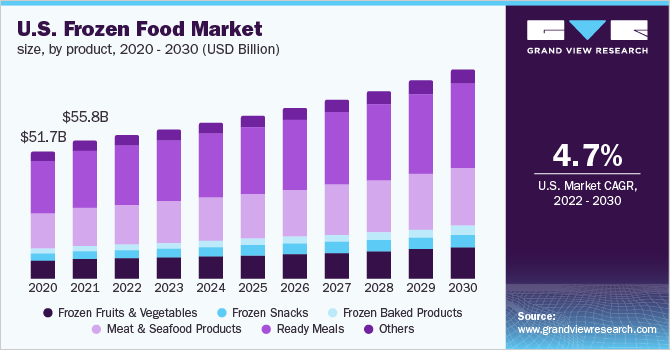
The U.S. frozen food market is expected to reach USD 84.58 billion by 2030, registering a CAGR of 4.7% during the forecast period 2022 to 2030 according to a new report by Grand View Research, Inc. Growth in the number of the millennial opting for the convenience foods is giving rise to the acceptance of frozen food in the U.S. These foods do not require any preservatives as microorganism do not grow when the temperature is low. Hence, making it a good option for the eatable between consumers.

 U.S. frozen food market size, by product, 2020 - 2030, (USD Billion)

Major food manufacturers have been ramping up their production capacity due to increased demand for frozen foods among consumers owing to safety and hygiene concerns. These products are packed well in containers, boxes, and bags hence making them a safe option for consumption. According to an article published in Food Dive, April 2020, four categories of frozen food section witnessed unprecedented growth including frozen meat (101%), frozen snacks (82.3%), and frozen beverages (94.6%) due to their convenience to cook as most of the restaurants were shut down during the pandemic due to safety protocols in the country.

U.S. Frozen Food Market Segmentation

Grand View Research has segmented the U.S. frozen food market based on the product, and distribution channel.

Based on the Product Insights, the market is segmented into Frozen Fruits & Vegetables, Frozen Snacks, Frozen Baked Products, Meat & Seafood Products, Ready Meals, and Others

  • The ready meals segment held the largest market share of 40.7% in 2021 and is expected to maintain dominance in the forecast period.
  • The segment for ready meals is developing rapidly due to the factors such as the prevalence of a fast-paced lifestyle, especially in urban areas, which is leading to increased demand for precooked foods including frigid foods, among consumers, to save time.
  • However, frozen baked products are projected to register the fastest growth during the forecast period with a CAGR of 5.8% from 2022 to 2030.
  • Moreover, product launches in this segment are likely to bode well with future segment growth. For instance, in September 2020 Levain’s-NewYork-based bakery shop announced the launch of frozen cookies in supermarkets. The product line includes Levain’s signature chocolate-walnut, variations of its two-chip and dark chocolate chip.

Based on the Distribution Channel Insights, the market is segmented into Offline and Online

  • Offline was a larger distribution channel with a market share of around 87.2% in the regional revenue during 2021. This distribution channel includes supermarket/hypermarkets, convenience stores, grocery stores, and local shops.
  • The availability of a wide range of chilled foods such as peas, chips, fish fillets, bread, pizza sausages, and chicken in such stores also plays a key role in driving this segment’s growth.
  • The online distribution channel is anticipated to register faster growth during forecast years with a CAGR of 5.1% from 2022 to 2030. The rising preference of consumers toward online grocery shopping and demand for user-friendly interfaces and additional discounts has been fueling the demand for this segment.

Key Companies Profile & Market Share Insights

The U.S. frozen food market is highly fragmented with the presence of a large number of regional and local players. Companies have been implementing various expansion strategies, such as partnerships and new product launches, to stay ahead in the game.

Some prominent players in the U.S. Frozen Food market include:

  • Cargill, Incorporated
  • Nestlé S.A.
  • Kraft Heinz Company
  • General Mills, Inc.
  • ConAgra Foods, Inc.
  • Ajinomoto Co., Inc.
  • McCain Foods
  • Nomad Foods Ltd.
  • Bellisio Foods
  • Wawona Frozen Foods

Order a free sample PDF of the U.S. Frozen Food Market Intelligence Study, published by Grand View Research.

Smartphone Screen Protector Market Revenue Opportunities and Gross Margin Analysis

Smartphone Screen Protector Industry Overview

The global smartphone screen protector market size is expected to reach USD 84.96 billion by 2030, according to a new report by Grand View Research, Inc. It is expected to expand at a CAGR of 6.8% from 2022 to 2030. The demand for smartphone screen protectors is projected to be influenced by the rising concerns over the safety of smartphones from screen damage caused by high-impact drops and scratches over the forecast period.

U.S. smartphone screen protector market size, by price range, 2020 - 2030 (USD Billion)

A large number of individuals use smartphones all across the world. Because of their increasing popularity, a variety of add-on devices have been developed to improve the overall functionality of smartphone devices. One such item is a smartphone screen protector, which, as the name implies, shields the phone's screen against scratches and other forms of damage. In the coming years, technological improvements in product development, such as the increased use of 3D technology, which improves user experience, are expected to provide profitable prospects for smartphone screen protector makers.

Smartphone Screen Protector Market Segmentation

Grand View Research has segmented the global smartphone screen protector market on the basis of material, price range, and region:

Based on the Material Insights, the market is segmented into Tempered Glass, Polyethylene Terephthalate, and Thermoplastic Polyurethane

  • The tempered glass segment accounted for the largest revenue share of over 90.0% in 2021. The segment growth can be attributed to the benefits of employing glass, as opposed to PT and TPU.
  • The oleophobic layer on tempered glass reduces fingerprints and provides the phone the sense of real glass while in use. These glasses feature superior light transmittance than other options, reduce glare, and scatter reflections.
  • The market trends will be fueled by mobile phone users' consistent adoption of tempered glass.
  • The thermoplastic polyurethane segment is projected to register a CAGR of 5.4% from 2022 to 2030. Among the benefits of using this type of screen protector is the fact that it's resistant to scratches, oil buildup, and grease.

Based on the Price Range Insights, the market is segmented into Below USD 175, USD 175 - 250, USD 250 - 450, USD 450 - 550, USD 550 - 700, and Above USD 700

  • The USD 550 - 700 segment dominated the market and held a revenue share of over 20.0% in 2021. It is also expected to expand at the fastest CAGR from 2022 to 2030.
  • The below USD 175 segment is anticipated to grow over the forecast period due to the increased demand from low-income people.
  • The above USD 700 segment is expected to register a significant CAGR from 2022 to 2030. The segment is expected to rise to over 475 million units by 2024 due to the rising demand for premium smartphones over the projected period.
  • Furthermore, increased concerns over the safety of high-priced cellphones are predicted to fuel product growth.

Smartphone Screen Protector Regional Outlook

  • North America
  • Europe
  • Asia Pacific
  • South & Central America
  • Middle East & Africa (MEA)

Key Companies Profile & Market Share Insights

The market includes both international and domestic participants. Key market players focus on strategies such as innovation and new products to enhance their portfolio offering in the market. For instance, in September 2021, Belkin, a global consumer electronics leader, unveiled two new screen protectors for the iPhone 13 Pro, iPhone 13 Pro Max, iPhone 13, and iPhone 13 small. Belkin's extensive screen protection portfolio for iPhone includes the UltraGlass Screen Protector and Anti-Glare Screen Protector.

Some prominent players in the global Smartphone Screen Protector market include:

  • IntelliARMOR
  • AZ Infolink Private Limited
  • Halloa Enterprise Co. Ltd.
  • ZAGG Inc.
  • Belkin International, Inc.
  • Corning Inc.
  • Ryan Technology Co. Ltd.
  • NuShield Inc.
  • Xtreme Guard
  • Free S.speed International Co., Ltd.
  • Clarivue
  • Jiizii Glass
  • Protek
  • FeYong Digital Technology Limited
  • Shenzhen Yoobao Technology Co. Ltd.

Order a free sample PDF of the Smartphone Screen Protector Market Intelligence Study, published by Grand View Research.

Beyond Patent Cliffs: What Is Really Fueling Expansion in the Biosimilars Market

Biologic drugs transformed the treatment of cancer, autoimmune disease, and diabetes, but their cost has kept many patients and health syste...