Showing posts with label Medical Foods Market. Show all posts

Medical Foods Market Environmental Landscape and Consumer Behavior Analysis Report by 2030

Medical Foods Industry Overview

The global medical foods market size is expected to reach USD 33.5 billion by 2030, according to a new report by Grand View Research, Inc. It is expected to expand at a CAGR of 5.2% from 2023 to 2030. Increasing incidences of chronic diseases, the rising geriatric population, and the growing burden of malnutrition are the major factors responsible for the substantial growth of the market over the years. For instance, according to a WHO report, about 149 million children under 5 were stunted and 38.9 million were obese or overweight due to undernutrition in 2020. The emerging focus of the policymakers to manage chronic disorders and nutritional deficiency is also anticipated to drive the adoption of medical foods over the years.
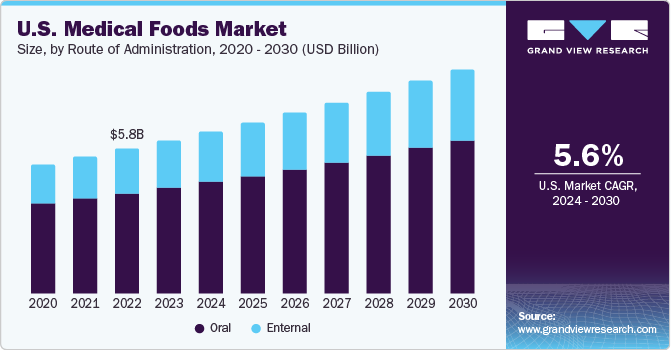
U.S. medical foods market size, by route of administration, 2020 - 2030 (USD Billion)

The oral route of the administration segment dominated the market with a revenue share of over 65.0% in 2022. The major factors contributing to the segment growth include a high preference for oral medical foods owing to the ease of consumption and high commercial viability of products administered orally. In addition, these foods are available in a variety of forms such as pills, powder, puddings, and pre-thickened products, thereby fueling the growth of the segment.

Medical Foods Market Segmentation

Grand View Research has segmented the global medical foods market on the basis of route of administration, product, application, sales channel, and region:

Based on the Route of Administration Insights, the market is segmented into Oral and Enteral

  • The oral segment dominated the market with a revenue share of over 65.0% in 2022. The common practice of oral route for the administration of clinical foods is the major factor anticipated to drive the segment over the years.
  • The enteral route of the administration segment is expected to witness the fastest growth over the forecast years. The growing prevalence of cardiovascular and chronic diseases resulting from several metabolic disorders leads to difficulty in oral food consumption and increases the preference for medical food feeding through enteral mode.

Based on the Product Insights, the market is segmented into Pills, Powder, Liquid, and Others

  • The powder segment accounted for the largest revenue share of over 35.0% in 2022 owing to the high commercial availability of medical foods in the form of powder.
  • In addition, increasing preference and ease in consumption by the pediatric and geriatric patients suffering from different chronic diseases are fueling the segment growth.
  • The liquid segment is anticipated to grow at the fastest rate during the forecast period owing to the rising adoption of liquid formulations in the pediatric and geriatric population.
  • The ease of administration of liquid-based medical foods and the commercial viability of these products will drive the segment.

Based on the Application Insights, the market is segmented into Chronic Kidney Disease, Minimal Hepatic Encephalopathy, Chemotherapy-induced Diarrhea, Pathogen Related Infections, Diabetic Neuropathy, ADHD, Depression, Alzheimer's Disease, Nutritional Deficiency, Orphan Diseases, Wound Healing, Chronic Diarrhea, Constipation Relief, Protein Booster, Dysphagia, Pain Management, Parkinson's Disease, Epilepsy, Other Cancer Related Treatments, Severe Protein Allergy, and Other

  • Chemotherapy-induced diarrhea accounted for the largest revenue share of over 15.0% in 2022.
  • Diarrheal episodes interfere with the chemotherapy process and dosage pattern. Therefore, the rising need for adopting medical foods in dietary management is expected to boost the segment growth.
  • Diabetic neuropathy is anticipated to be the fastest-growing segment over the forecast period owing to the growing prevalence of diabetes and a rise in the number of patients that are at risk of developing some level of neuropathy.
  • Moreover, an increase in the preference to consume medical foods loaded with vitamin B-12, omega 3 fatty acids, and lipoid acid to manage diabetic neuropathy is anticipated to boost the segment growth over the coming years.

Medical Foods Regional Outlook

  • North America
  • Europe
  • Asia Pacific
  • Latin America
  • Middle East & Africa (MEA)

Key Companies Profile & Market Share Insights

Increasing demand for medical foods by patients and healthcare professionals and the growing market consolidation activities by the market players to hold a strong position is resulting in strong competition among the competitors. Several strategies have been adopted by the key players such as high investments in new product development and geographic expansion to increase their revenue share. In addition, the top market players are looking for strategic acquisitions, mergers, and partnerships to expand their product reach and increase revenue share in the global market.

Some prominent players in the global Medical Foods market include:

  • Nestle
  • Danone
  • Abbott
  • Mead Johnson & Company, LLC
  • Fresenius Kabi
  • Targeted Medical Pharma, Inc.
  • Primus Pharmaceuticals, Inc.
  • Medtrition, Inc.

Order a free sample PDF of the Medical Foods Market Intelligence Study, published by Grand View Research.

Medical Foods Market Social Landscape and Consumer Behavior Analysis Report by 2030

Medical Foods Industry Overview

The global medical foods market size was valued at USD 21.2 billion in 2021 and is expected to expand at a compound annual growth rate (CAGR) of 5.2% from 2022 to 2030. The growing prevalence of communicable and non-communicable diseases and increasing effort for the dietary management of those diseases are anticipated to propel the market growth over the forecast years. For instance, as per the research data published by the University of Liege, it has been estimated that in Europe, the sarcopenia population will increase to 12.9% by 2045 from 11.1% in 2016. 

U.S. medical foods market size, by route of administration, 2020 - 2030 (USD Billion)

The increasing geriatric population suffering from several chronic and neurogenic disorders such as dementia, stroke, multiple sclerosis, and difficulty in swallowing requires specific dietary management, which, in turn, is expected to drive the market over the forecast years. For instance, according to the WHO, the world population aged over 60 years of age is expected to be doubled from 12% to 22% between the years 2015 and 2050. Furthermore, increasing preference to consume specific foods in order to manage chronic diseases such as obesity, diabetes, and other nutritional diseases is anticipated to drive the adoption of medical foods. 

In addition, medical foods are intended for specific dietary management with distinctive nutritional requirements to treat specific diseases, which are expected to drive the market. Growing product launch activities by the manufacturers and constant innovations in product development are the major factors anticipated to propel the product demand. Besides, in order to treat new inherited metabolic disorders and manage their incurable condition, there is a growing demand for the development of new food for special medical purposes. 

Gather more insights about the market drivers, restraints, and growth of the Global Medical Foods market

In addition, increasing consideration of medical foods to manage and control diabetic neuropathy and diabetes is expected to accelerate the market growth. Diabetes is one of the major chronic diseases and the prevalence has been constantly rising. According to the WHO data published in 2019, approximately 1.5 million deaths are caused directly due to diabetes and it was considered to be the ninth leading cause of death. An unhealthy lifestyle and diet are the leading causes of diabetic neuropathy and medical foods act as a remedy to improve and manage these kinds of disorders. For instance, as per the International Diabetic Federation data in 2019, about 463 million adults are living with diabetes and this number will rise to 700 million by 2045. 

Several industry consolidation activities by the manufacturers in the clinical nutrition industry are also expected to propel the market growth over the forecast years. Activities by the manufacturers such as acquisitions, mergers, product launches, and partnerships to enhance their product reach are expected to propel market growth over the coming years. For instance, in January 2020, Nestle entered into an Asset Purchase Agreement to expand its business of clinical nutrition by acquiring Zenpen. 

In addition, the COVID-19 pandemic is boosting the growth of the market and is projected to support the growth in the coming years. For instance, as per an article published in 2020 in The House, medical foods are expected to play a significant role in the recovery and rehabilitation process of patients suffering from the disease. Moreover, owing to the rising burden on critical care services due to the pandemic, the demand for nutritional support and dietetic care is rising, thereby propelling the market growth, penetration, and adoption of medical foods. Hence, the COVID-19 pandemic is projected to fuel the growth of the market during the forecast period. 

Browse through Grand View Research's Pharmaceuticals Industry Research Reports.

Europe Medical Foods Market - The Europe medical foods market size was valued at USD 5.6 billion in 2021 and is expected to expand at a compound annual growth rate (CAGR) of 2.9% from 2022 to 2030.

Medical Foods For Orphan Diseases Market - The global medical foods for orphan diseases market size was valued at USD 1.2 billion in 2022 and is expected to expand at a compound annual growth rate (CAGR) of 5.5% from 2023 to 2030.

Medical Foods Market Segmentation

Grand View Research has segmented the global medical foods market on the basis of route of administration, product, application, sales channel, and region:

Medical Foods Route of Administration Outlook (Revenue, USD Million, 2016 - 2030)

  • Oral
  • Enteral

Medical Foods Product Outlook (Revenue, USD Million, 2016 - 2030)

  • Pills
  • Powder
  • Liquid
  • Others

Medical Foods Application Outlook (Revenue, USD Million, 2016 - 2030)

  • Chronic Kidney Disease
  • Minimal Hepatic Encephalopathy
  • Chemotherapy-induced Diarrhea
  • Pathogen Related Infections
  • Diabetic Neuropathy
  • ADHD
  • Depression
  • Alzheimer's Disease
  • Nutritional Deficiency
  • Orphan Diseases
  • Wound Healing
  • Chronic Diarrhea
  • Constipation Relief
  • Protein Booster
  • Dysphagia
  • Pain Management
  • Parkinson's Disease
  • Epilepsy
  • Other Cancer Related Treatments
  • Severe Protein Allergy
  • Other

Medical Foods Sales Channel Outlook (Revenue, USD Million, 2016 - 2030)

  • Online Sales
  • Institutional Sales
  • Retail Sales

Medical Foods Regional Outlook (Revenue, USD Million, 2016 - 2030)

  • North America
  • Europe
  • Asia Pacific
  • Latin America
  • Middle East & Africa

Market Share Insights

October 2020: Nestle Health Science launched protein-based ready-to-drink nutritional food in China for special medical purposes (FSMPs). The main component of that drink is a galactomannan, a highly soluble dietary fiber, which can improve and prevent gastrointestinal intolerance and diarrhea. In addition,

Key Companies profiled:

Some prominent players in the global medical foods market include:

  • Nestle
  • Danone
  • Abbott
  • Mead Johnson & Company, LLC
  • Fresenius Kabi
  • Targeted Medical Pharma, Inc.
  • Primus Pharmaceuticals, Inc.
  • Medtrition, Inc. 

Order a free sample PDF of the Medical Foods Market Intelligence Study, published by Grand View Research.

Urban Growth and Electricity Demand Expand the Footprint of the Protective Relay Market

Protective relays rarely make headlines, but power systems depend on them. They detect faults, isolate the affected section in milliseconds,...