Digital Signage Market Growth Is Driven By Increasing Demand From Retail And Healthcare Industry

Digital Signage Industry Overview

The global digital signage market size was estimated at USD 23.12 billion in 2021 and is expected to expand at a compound annual growth rate (CAGR) of 7.7% from 2022 to 2030.

This market growth is accredited to the increasing demand for the digitized promotion of products and services to attract the attention of the target audience in an effective manner. Furthermore, the demand for 4K digitized sign displays with the embedded software and media player is rising as it offers customers an affordable Ultra HD digital signage solution, which is also expected to drive the demand. The evolution of innovative products, such as home monitoring systems, leak detector systems, and so on, along with complicated monetary products, such as forex cards, that need informative and succinct advertisement content are some of the factors that are predicted to drive the product demand.

Gather more insights about the market drivers, restrains and growth of the Global Digital Signage Market

Moreover, there is a rising demand for adopting advanced products that require digitized information management and guidance that can be accessed from remote locations. This is one of the key drivers anticipated to drive the global industry during the forecast period. Digitized signs offer the necessary quality information to a large number of viewers by utilizing large display screens across the location with a concentrated target audience. With digitized display technology, information is provided in a digitized format that includes motion and pictures to attract customers with more impact as compared to the traditional modes of reaching out to customers. In addition, the integration of biometric technology with modern digitized signs has developed products, such as track heat paths and gaze tracking.
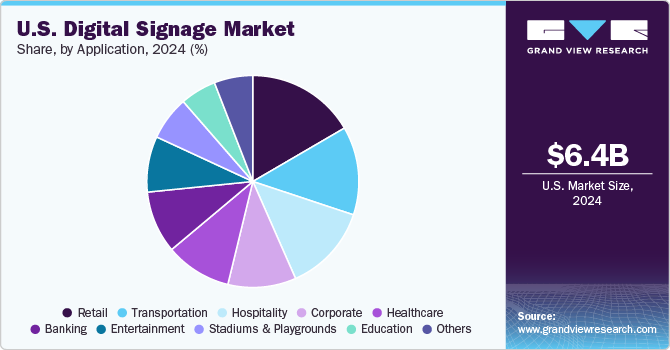
U.S. digital signage market size, by type, 2020 - 2030 (USD Billion)

Gaze tracking technology helps in locating the area, which is crowded with a greater number of consumers, thereby helping the companies to track the consumer behavior for effective marketing of products. Thus, the growing use of the aforementioned technology is expected to strengthen the demand in the next few years. Eventually, the growing awareness among the consumers regarding the drawbacks and complexity of traditional advertising, such as short-lived print marketing and so on, is instigating digitized advertisement adoption. Furthermore, display designers, researchers, and advertisement companies are spending more on the improvement of the product’s display technology.

All these factors are expected to catalyze the overall industry growth. With the advancement in display technologies, the evolution of LCD, LED, UHD, OLED, and Super AMOLED is further strengthening the industry growth. These technologies have led to the enhancement of the quality of advertisement content, thus creating a favorable impact on the target audience. The adoption of such technologies by digital poster providers is anticipated to boost the overall industry growth. However, factors, such as software & hardware compatibility, electrical interface, and connectivity, are some prevailing issues that may hinder the market growth. Moreover, the complex taxations levied upon the erection of digitized signs and screens, coupled with the regulatory processes, such as licensing, are projected to hamper the growth.

Browse through Grand View Research's Display Technologies Industry Related Reports

  • U.S. Digital Signage Market - The U.S. digital signage market size was valued at USD 5.3 billion in 2021 and is expected to expand at a compound annual growth rate (CAGR) of 6.3% from 2022 to 2030.
  • Interactive Video Wall Market - The global interactive video wall market size was valued at USD 4.47 billion in 2018 and is expected to expand at a CAGR of 10.1% over the forecast period. Increasing adoption of interactive displays at public transportation/transit spaces, such as airports and railway stations is anticipated to drive the growth.

Market Share Insights

June 2021: Sony Corporation introduces BZ35J and BZ30J series of 4K HDR BRAVIA professional displays. It will help to customize settings and quick optimization.

February 2017: Intel Corp. introduced Open Pluggable Specification (OPS), which has helped in standardizing the design of digitized marketing.

Key Companies profiled:

Some prominent players in the global Digital Signage market include

  • ADFLOW Networks
  • BrightSign, LLC
  • Cisco Systems, Inc.
  • Intel Corporation
  • KeyWest Technology, Inc.
  • LG Electronics (LG Corp.)
  • Microsoft Corp.
  • NEC Display Solutions
  • Omnivex Corp.
  • Panasonic Corp.
  • SAMSUNG
  • Scala Digital Signage
  • Winmate Inc.

Order a free sample PDF of the Digital Signage Market Intelligence Study, published by Grand View Research.
Global Bicycle Market Size Is Expected To Reach USD 119.29 Billion By 2030

Bicycle Industry Overview

The global bicycle market size was valued at USD 59.33 billion in 2021 and is expected to expand at a compound annual growth rate (CAGR) of 8.2% from 2022 to 2030.

The increase in the number of people opting for bicycling as a form of leisure is anticipated to propel the market growth. Preference for bicycles as a convenient form of exercise to ensure a healthy life, free from obesity and other disorders, is expected to further boost the market expansion. The popularity of dockless bicycle-sharing systems has been rising lately. This system allows users to locate a bicycle nearby and unlock it electronically. Incepted originally in Europe, dockless bicycle-sharing systems are gaining popularity, particularly in Asian nations such as India and China.

Gather more insights about the market drivers, restrains and growth of the Global Bicycle Market

Furthermore, recent advancements in mobile app development and Global Positioning System (GPS) have resulted in app-based dockless bicycle-sharing systems. Moreover, the growing adoption of such dockless bicycle-sharing systems is anticipated to fuel the demand for cycles significantly. Chinese bicycle-sharing companies are particularly investing and expanding their operations aggressively in the European nations to capitalize on the market opportunities. This is expected to boost the market growth in the forthcoming years.

People have started realizing the importance of staying fit and having a healthy life. They have also started realizing that regular bicycling can keep disorders, such as obesity, at bay. The market is likely to grow as more and more people are resorting to bicycling as a regular form of exercise. Events such as Tour de France and Ronde van Vlaanderenare further add to the popularity of these vehicles. Meanwhile, a rise in bicycling events being organized in various countries from Asia, Africa, and the Middle East is fueling the sales of mountain and road bicycles.

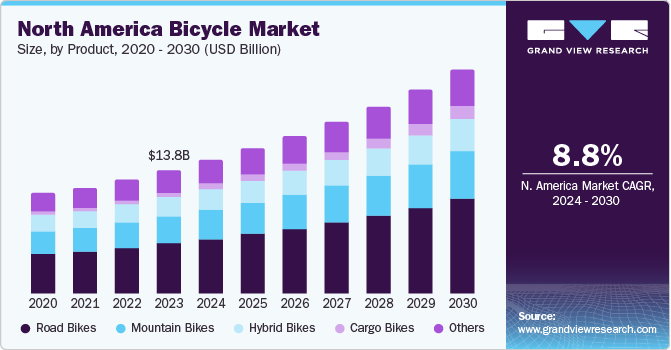
North America bicycle market size, by product, 2020 - 2030 (USD Billion)

The growing traffic congestions and shortage of parking space, particularly in metropolitan cities, are prompting people to consider bicycle commutation for short distances to save time. At the same time, various governments are aggressively rolling out the infrastructure necessary to support bicycle commutation, thereby encouraging people to opt for bicycles. However, the looming lack of the infrastructure necessary to support and encourage bicycle commutation, particularly in developing economies, such as India, is anticipated to hinder the growth of the market. Similarly, lightweight bicycles made using composite materials make them expensive, which does not bode well for the market expansion.

The outbreak of COVID-19 is certainly expected to favor the market growth in the coming years as several governments around the globe are significantly promoting bicycles as one of the safest-medium of transportation, which helps people to maintain social distancing. Besides, governments across key countries such as the U.K and Italy are providing subsidies on the purchase of new bicycles during the pandemic. Therefore, the government support in the form of initiatives and subsidies, coupled with growing awareness regarding benefits offered by bicycles, bodes well for the market growth over the next few years.

Browse through Grand View Research's Automotive & Transportation Industry Related Reports

  • Micro-mobility Market - The global micro-mobility market size was valued at USD 25.42 billion in 2020 and is expected to expand at a compound annual growth rate (CAGR) of 13.7% from 2021 to 2028. Factors such as increasing road congestion, rising oil & gas prices, ease of parking, and saturation within the automotive sector are expected to drive market growth during the forecast period.
  • E-bikes Market - The global e-bikes market size was valued at USD 17.83 billion in 2021 and is expected to expand at a compound annual growth rate (CAGR) of 13.5% from 2022 to 2030. Several governments are undertaking initiatives to mitigate carbon footprints by encouraging the use of electric vehicles, electric bikes, and bicycles.

Bicycle Market Segmentation

Grand View Research has segmented the global bicycle market on the basis of product, technology, end-user, distribution channel, and region:

  • Bicycle Product Outlook (Revenue, USD Million, 2017 - 2030)
    • Mountain Bikes
    • Hybrid Bikes
    • Road Bikes
    • Cargo Bikes
    • Others
  • Bicycle Technology Outlook (Revenue, USD Million, 2017 - 2030)
    • Electric
    • Conventional
  • Bicycle End-user Outlook (Revenue, USD Million, 2017 - 2030)
    • Men
    • Women
    • Kids
  • Bicycle Distribution Channel Outlook (Revenue, USD Million, 2017 - 2030)
    • Online
    • Offline
  • Bicycle Regional Outlook (Revenue, USD Million, 2017 - 2030)
    • North America
    • Europe
    • Asia Pacific
    • Latin America
    • Middle East & Africa

Market Share Insights

November 2021: PIERER Mobility AG acquired FELT Bicycles. With this acquisition, PIERER has planned to expand its operations in the North American market for bicycle. This acquisition was intended to serve a customer segment demanding customizing their bicycle according to their individual needs.

June 2019: Trek Bicycle Corporation introduced the all-new Madone SLR 6 Disc Speed. The bicycle is integrated with removable aero bars and specially designed for riding in hilly areas with winding roads.

Key Companies profiled:

Some prominent players in the global Bicycle market include

  • Accell Group
  • Atlas Cycles (Haryana) Ltd.
  • Avon Cycles Ltd.
  • Cervelo
  • Dorel Industries Inc.
  • Giant Bicycles
  • Merida Industry Co., Ltd.
  • Specialized Bicycle Components, Inc.
  • SCOTT Sports SA
  • Trek Bicycle Corporation

Order a free sample PDF of the Bicycle Market Intelligence Study, published by Grand View Research.
Which Are Growth Driving Factors Of The Adhesives And Sealants Market?

Adhesives And Sealants Industry Overview

The global adhesives and sealants market size was valued at USD 63.79 billion in 2021 and is expected to register a compound annual growth rate (CAGR) of 5.9% from 2022 to 2030.

Changes in material consumption patterns, wherein materials, such as aluminum, metal, and paper, are being replaced by highly durable materials. This is anticipated to positively affect the products demand in packaging applications, over the next eight years.

Gather more insights about the market drivers, restrains and growth of the Global Adhesives And Sealants Market

Consistent demand for packaging products from the food & beverage industry is anticipated to remain the key driver for the market in the U.S. Additionally, the increasing presence of discount retailers in the U.S. and the high potential for grocery retail is likely to push the adhesive demand for packaging products.  This, in turn, is likely to benefit the long-term growth of the market.

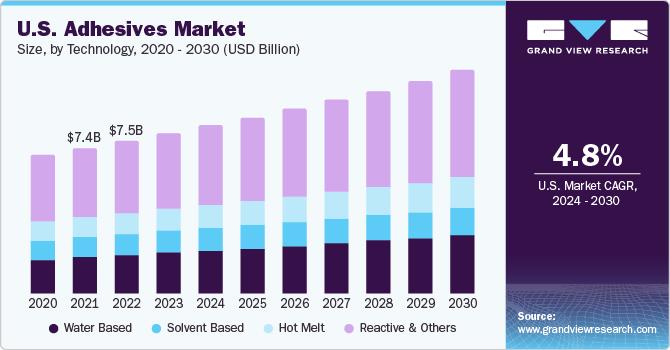
U.S. adhesives market size, by technology, 2020 - 2030 (USD Billion)

The paper & packaging application segment in the U.S. adhesives market is expected to emerge as the fastest-growing application segment at an estimated CAGR of 4.9% from 2022 to 2030. Increasing demand for bio-based products is expected to augment the demand for hot melt technology over the forecast period and contribute to the expansion of the paper & packaging segment.

The COVID-19 pandemic affected the adhesive & sealant products demand in the U.S. According to the government report, the GDP of the U.S. shrunk by 3.5% in 2020 from 2019, owing to a decline in the manufacturing output of end-use industries such as building & construction, automotive & transportation, aerospace & defense, packaging, and consumer. Overall, adhesives volume registered Y-O-Y growth of 0.4% in 2020.

Browse through Grand View Research's Chemical Industry Related Reports

  • Silicone Market - The global silicone market size was valued at USD 14.4 billion in 2020 and is expected to expand at a compound annual growth rate (CAGR) of 4.3% from 2021 to 2028. The growing demand for silicone in various end-user industries including construction, personal care, industrial process, and consumer goods is expected to drive market growth.
  • Hybrid Adhesives & Sealants Market - The global hybrid adhesives & sealants market size was estimated at USD 11.86 billion in 2017 and is projected to witness a CAGR of 8.3% from 2017 to 2025. Growing preference for hybrid resins in end-use industries, such as building and construction and automotive is expected to drive the global market.

Market Share Insights

January 2020: GE Sealants & Adhesives launched a new nine-product line which helps to protect painting projects of inside and outside home renovation.

September 2019: Bostik, an adhesive specialist launched a modified and innovative silicone sealant for back bedding applications..

Key Companies profiled:

Some prominent players in the global Adhesives And Sealants market include

  • 3M Company
  • Ashland Inc.
  • Avery Denison Corporation
  • H B Fuller
  • Henkel AG
  • Sika AG
  • Pidilite Industries
  • Huntsman
  • Wacker Chemie AG
  • RPM International Inc.

Order a free sample PDF of the Adhesives And Sealants Market Intelligence Study, published by Grand View Research.
AI Training Dataset Market Is Anticipated To Expand At A CAGR of 22.2% From 2022 To 2030

AI Training Dataset Industry Overview

The global AI training dataset market size was valued at USD 1,408.5 million in 2021 and is anticipated to expand at a compound annual growth rate (CAGR) of 22.2% from 2022 to 2030.

AI is gaining significant importance in various industry applications such as manufacturing, IT, BFSI, retail, and ecommerce, and healthcare. The growing demand for application-specific training data is also opening opportunities for new entrants. Artificial Intelligence (AI) is becoming vital to big data as the technology allows the extraction of high-level and complex abstractions using a hierarchical learning process leading to the need for mining and extracting meaningful patterns from voluminous data.

Gather more insights about the market drivers, restrains and growth of the Global AI Training Dataset Market

The AI enables machines to learn from experience, perform human-like tasks, and adjust to new inputs. These machines are trained to process massive data and determine patterns to accomplish a specific task. In order to train these machines, certain datasets are required. To cater to this requirement, the demand for artificial intelligence training datasets is increasing. The working of machines entirely depends on the dataset provided. Thus, it becomes essential to provide high-quality datasets for training. This high-quality dataset enhances the performance of AI. It also helps in reducing the time required to prepare data and increases the accuracy of predictions. Thus, vendors in the market are also focusing on acquiring companies that can help them to enhance the quality of data.

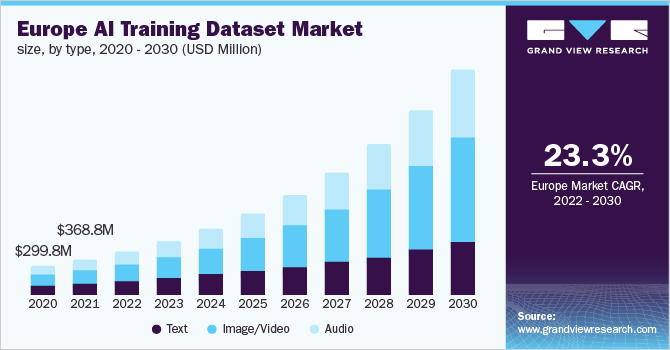
Europe AI training dataset market size, by type, 2020 - 2030 (USD Million)

For instance, in March 2020, Appen Limited, a specialized dataset provider, announced the acquisition of Figure Eight Inc., a provider of the machine learning platform. The latter company creates high-quality data by transforming unlabeled data with the help of automated tools. This acquisition will help the former company to increase the creation speed of a high-quality training dataset. It will also help in enhancing the quality of data.

Browse through Grand View Research's Next Generation Technologies Industry Related Reports

  • Machine Learning Market - The global machine learning market size was valued at USD 6.9 billion in 2018 and is anticipated to register a CAGR of 43.8% from 2019 to 2025. Emerging technologies such as artificial intelligence are changing the way industries and humans work.
  • LiDAR Market - The global LiDAR market size was valued at USD 1.1 billion in 2019 and is expected to register a CAGR of 13.2% over the forecast period. The technological advancements in spatial resolution of LiDAR-based digital terrain models provide incredible accuracy in applications such as change detection on hillsides, water runoff for agriculture or mining sites, and inland waterways.

AI Training Dataset Market Segmentation

Grand View Research has segmented the global AI training dataset market based on type, vertical, and region:

  • AI Training Dataset Type Outlook (Revenue, USD Million, 2017 - 2030)
    • Text
    • Image/Video
    • Audio
  • AI Training Dataset Vertical Outlook (Revenue, USD Million, 2017 - 2030)
    • IT
    • Automotive
    • Government
    • Healthcare
    • BFSI
    • Retail & E-commerce
    • Others
  • AI Training Dataset Regional Outlook (Revenue, USD Million, 2017 - 2030)
    • North America
    • Europe
    • Asia Pacific
    • South America
    • Middle East & Africa

Market Share Insights

January 2021: Vector Space AI, a datasets provider, entered into a collaboration with Elasticsearch B.V., a search company. The former company will be providing AI datasets to its users that are built in collaboration with the latter company. Vectorspace AI launched datasets that will power AI, ML and data engineering.

September 2020: Waymo LLC, a Google LLC company, released a new dataset for autonomous vehicles. This dataset comprises sensor data that has been collected from camera sensors and LiDAR under various driving conditions such as cyclists, pedestrians, signage, and others. Such developments are driving the adoption of training datasets in the market, thereby catering to a high share in the market for AI training dataset.

Key Companies profiled:

Some prominent players in the global AI Training Dataset market include

  • Google, LLC (Kaggle)
  • Appen Limited
  • Cogito Tech LLC
  • Lionbridge Technologies, Inc.
  • Amazon Web Services, Inc.
  • Microsoft Corporation
  • Scale AI Inc.
  • Samasource Inc.
  • Alegion
  • Deep Vision Data

Order a free sample PDF of the AI Training Dataset Market Intelligence Study, published by Grand View Research.
Increasing Demand For VFX In Movie Production Studios Drive The Growth To Virtual Production Market

Virtual Production Industry Overview

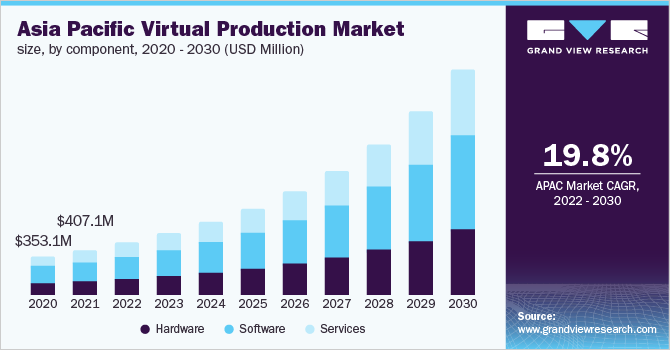
The global virtual production market size was valued at USD 1.60 billion in 2021 and is expected to expand at a compound annual growth rate (CAGR) of 17.8% from 2022 to 2030.

Virtual production enables filmmakers to interactively visualize and explore digital scenes such as realistic virtual characters, three-dimensional graphics, and a real-time virtual interactive background environment within the studio. Vast developments in the field of virtual production over the years have led to the introduction of solutions that allow filmmakers to transfer the motion-captured movement of an actor to virtual characters, which are then previewed in real-time, in combination with live-action footage and virtual set extension elements. Such solutions help filmmakers plan and communicate their creative ideas in new and more intuitive ways. The increasing demand for visual effects (VFX) in movie production studios worldwide and the rising application of virtual production in commercial ads are likely to boost the market growth over the forecast period. During the pandemic, in 2020, prominent Hollywood filmmakers, including NBC, MTV, and ABC, began adopting virtual production using cloudbusting, which involved using a robotic camera like the Solo Cinebot to shoot the actors remotely.

Gather more insights about the market drivers, restrains and growth of the Global Virtual Production Market

The increased adoption of the LED video wall technology is augmenting the implementation of virtual production across the media and entertainment sectors. LED video walls display computer-generated graphics in the background and enable filmmakers to capture visual effects in real-time. The LED video wall technology has substituted a green screen, making film production more accessible after the break of Covid-19. For instance, in April 2020, ABC's show SkyLine filmed all their real-life scenes in a 360-degree camera and displayed them on the LED screen instead of the green screen. LED video wall screens create a realistic background visual that replaces an actual shoot location while saving the entire crew time and money. For instance, The Mandalorian TV series has extensively used semicircular LED video walls for the in-house shoot and the virtual production technology for overall production, eliminating the need for on-location shoots. Disney used LED walls of dimensions 20-feet high, 75-feet wide, and 270-degree, which made it possible to present the movement of the 3D image concerning the camera's movement.

 Asia Pacific virtual production market size, by component, 2020 - 2030 (USD Million)

The rising popularity of web series containing visual effects and three-dimensional graphic environments encourages video-makers to implement virtual production technology in their video content. Popular web and television series such as Games of Thrones, The Last Kingdom, Black Mirror, and Outlander have extensively implemented visual graphics to create epic and historical scenes. VFX helps produce high-quality video content with realistic graphic characters and artificial scenes that enrich the viewing experience. Moreover, virtual production technology helps reduce video production costs by eliminating the need to shoot at expensive sites and bringing pre-visualization (a part pre-production process) on set. Pre-visualization creates a first three-dimensional representation of the final visual effects action sequence to help moviemakers plan out camera placement and other creative/technical requirements.

With the advent of advanced technologies in virtual production, filmmakers can create more advanced computer graphic characters using facial-capture training data to transform visuals into real-time characters. The most recent example of advanced visual effects is the transformation of actor Josh Brolin’s face into the lead villain Thanos in the latest Marvel Avengers Movies. Furthermore, artificial intelligence and machine learning features are expected to enhance the quality of visual effects further and simplify the design process of a three-dimensional model. Furthermore, the growing applications of artificial intelligence in content creation for action simulation, three-dimensional texturing, and post-process motion-capturing data are expected to lead to the development of advanced visual effect software functions in the near future.

Browse through Grand View Research's Next Generation Technologies Industry Related Reports

  • Artificial Intelligence Market - The global artificial intelligence market size was valued at USD 93.5 billion in 2021 and is projected to expand at a compound annual growth rate (CAGR) of 38.1% from 2022 to 2030. The continuous research and innovation directed by the tech giants are driving the adoption of advanced technologies in industry verticals, such as automotive, healthcare, retail, finance, and manufacturing.
  • Deep Learning Market - The global deep learning market size was valued at USD 34.8 billion in 2021 and is expected to expand at a compound annual growth rate (CAGR) exceeding 34.3% from 2022 to 2030. The technology is gaining prominence because of advancements in data center capabilities, high computing power, and the ability to perform tasks without human interactions.

Virtual Production Market Segmentation

Grand View Research has segmented the global virtual production market based on component, type, end-user, and region:

  • Virtual Production Component Outlook (Revenue, USD Million, 2017 - 2030)
    • Hardware
    • Software
    • Services
  • Virtual Production Type Outlook (Revenue, USD Million, 2017 - 2030)
    • Pre-production
    • Production
    • Post-production
  • Virtual Production End-user Outlook (Revenue, USD Million, 2017 - 2030)
    • Movies
    • TV Series
    • Commercial Ads
    • Online Videos
    • Others
  • Virtual Production Regional Outlook (Revenue, USD Million, 2017 - 2030)
    • North America
    • Europe
    • Asia Pacific
    • South America
    • Middle East & Africa

Market Share Insights

November 2020: Epic Games Inc. acquired Quixel, a photogrammetry asset library company that makes three-dimensional models based on high-definition photography. With the acquisition, Epic Games Inc. aims to provide Quixel’s existing library of models to Unreal Engine users.

March 2020: Epic Games Inc. acquired Cubic Motion, a highly detailed digital facial animations provider for both films and video games. The acquisition would further enrich visuals and three-dimensional graphic environments for the users of Epic Games Inc. solutions.

Key Companies profiled:

Some prominent players in the global Virtual Production market include

  • 360Rize
  • Adobe
  • Arashi Vision Inc. (Insta 360)
  • Autodesk Inc.
  • BORIS FX, INC.
  • Epic Games, Inc.
  • HTC Corporation (VivePort)
  • HumanEyes Technologies
  • Mo-Sys Engineering Ltd.
  • NVIDIA Corporation
  • com
  • Pixar (The Walt Disney Company)
  • Side Effects Software Inc. (SideFX)
  • Technicolor
  • Vicon Motion Systems Ltd.

Order a free sample PDF of the Virtual Production Market Intelligence Study, published by Grand View Research.
The Global Artificial Intelligence Market Size Is Projected To Reach $ 1,811.8 Billion By 2030

Artificial Intelligence Industry Overview

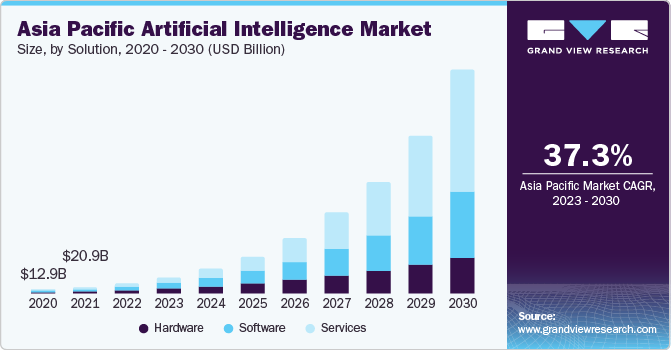
The global artificial intelligence market size was valued at USD 93.5 billion in 2021 and is projected to expand at a compound annual growth rate (CAGR) of 38.1% from 2022 to 2030.

The continuous research and innovation directed by the tech giants are driving the adoption of advanced technologies in industry verticals, such as automotive, healthcare, retail, finance, and manufacturing. For instance, In November 2020, Intel Corporation acquired Cnvrg.io., an Israeli company that develops and operates a platform for data scientists to build and run machine learning models, to boost Artificial Intelligence (AI) business. However, technology has always been an essential element for these industries, but AI has brought technology to the center of organizations.

Gather more insights about the market drivers, restrains and growth of the Global Artificial Intelligence Market

For instance, from self-driving vehicles to crucial life-saving medical gear, AI is being infused virtually into every apparatus and program. AI is proven to be a significant revolutionary element of the upcoming digital era. Tech giants like Amazon.com, Inc.; Google LLC; Apple Inc.; Facebook, International Business Machines Corporation, and Microsoft are investing significantly in the research and development of AI. These companies are working to make AI more accessible for enterprise use-cases. Moreover, various companies adopt AI technology to provide a better customer experience. For instance, in March 2020, McDonald’s made its most significant tech investment of USD 300 million to acquire AI start-up Tel Aviv to provide a personalized customer experience using AI.

The essential fact accelerating the rate of innovation in AI is accessibility to historical datasets. Since data storage and recovery have become more economical, healthcare institutions and government agencies build unstructured data accessible to the research domain. Researchers are getting access to rich datasets from historic rain trends to clinical imaging. The next-generation computing architectures, with access to rich datasets, are encouraging information scientists and researchers to innovate faster. Furthermore, progress in profound learning and ANN (Artificial Neural Networks) has also fueled the adoption of AI in several industries, such as aerospace, healthcare, manufacturing, and automotive. 

Asia Pacific artificial intelligence market size, by solution, 2020 - 2030 (USD Billion)

ANN works in recognizing similar patterns and helps in providing modified solutions. Tech companies like Google Maps have been adopting the ANN to improve their route and work on the feedback received using the ANN. ANN is substituting conventional machine learning systems to evolve precise and accurate versions. For instance, recent advancements in computer vision technology, such as GAN (Generative Adversarial Networks) and SSD (Single Shot MultiBox Detector), have led to digital image processing techniques. For instance, images and videos were taken in low light, or low resolution can be transformed into HD quality by employing these techniques. The continuous research in computer vision has built the foundation for digital image processing in security and surveillance, healthcare, and transportation, among other sectors. Such emerging machine learning methods are anticipated to alter the manner AI versions are trained and deployed.

The WHO has declared the novel coronavirus (COVID-19) outbreak a pandemic, causing a massive impact on businesses and humankind. This pandemic has emerged as an opportunity for AI-enabled computer systems to fight against the epidemic as several tech giants and start-ups are working on preventing, mitigating, and containing the virus. For instance, the Chinese tech giant Alibaba's research institute Damo Academy has developed a diagnostic algorithm to detect new coronavirus cases with the chest CT (Computed Tomography) scan. The AI model used in the system has been trained with the sample data from over 5,000 positive coronavirus cases. For instance, in June 2020, Lunit developed an AI solution for x-ray analysis of the chest for simpler management of Covid-19 cases and offered assistance in interpreting, monitoring, and patient trials.

COVID - 19 outbreak is expected to stimulate the market growth of next-generation tech domains, including artificial intelligence, owing to the mandated WFH (work-from-home) policy due to this pandemic. For instance, LogMeIn, Inc., a U.S.-based company that provides SaaS (Software-as-a-Service) and cloud-based customer engagement and remote connectivity and collaboration services, has experienced a significant increase in new sign-ups across its product portfolios amid the pandemic. Also, tech companies are expanding their product offerings and services to widen availability across the globe. For instance, in April 2020, Google LLC launched an AI-enabled chatbot called Rapid Response Virtual Agent for call centers. This chatbot is built to respond to issues customers might be experiencing due to the coronavirus (COVID-19) outbreak over voice, chat, and other social channels.

Browse through Grand View Research's Technology Industry Related Reports

  • Computed Tomography Market - The global computed tomography (CT) market size was valued at USD 5.53 billion in 2018 and is projected to expand at a CAGR of 6.5% by 2026. Growing prevalence of various lifestyles associated with chronic diseases such as cancer and cardiovascular conditions and increasing demand for advanced imaging solutions are some of the factors expected to drive the overall market growth.
  • Chatbot Market - The global chatbot market size was estimated at USD 430.9 million in 2020. It is expected to expand at a compound annual growth rate (CAGR) of 24.9% from 2021 to 2028. The growth is expected to be driven by the increasing adoption of customer service activities among enterprises to reduce operating costs..

Market Share Insights

April 2020: Advanced Micro Devices announced a strategic alliance with Oxide Interactive LLC, a video game developer company, to develop graphics technologies for the cloud gaming market space. Both companies have planned to create a set of tools and techniques to address the real-time demands of cloud-based gaming.

December 2019: Intel Corporation completed the acquisition of Habana Labs Ltd., an Israel-based deep learning company. This acquisition is anticipated to strengthen Intel Corporation’s AI portfolio and boost its efforts in the AI silicon market.

Key Companies profiled:

Some prominent players in the global Artificial Intelligence market include

  • Advanced Micro Devices
  • AiCure
  • Arm Limited
  • Atomwise, Inc.
  • Ayasdi AI LLC
  • Baidu, Inc.
  • Clarifai, Inc
  • Cyrcadia Health
  • Enlitic, Inc.
  • Google LLC
  • HyperVerge, Inc.
  • International Business Machines Corporation
  • IBM Watson Health
  • Intel Corporation
  • Lifegraph
  • Microsoft
  • NVIDIA Corporation
  • Sensely, Inc.
  • Zebra Medical Vision, Inc.

Order a free sample PDF of the Artificial Intelligence Market Intelligence Study, published by Grand View Research.
The B2B Segment Led Optical Character Recognition Market In 2021 With 75.0% Share Of The Global Revenue

Optical Character Recognition Industry Overview

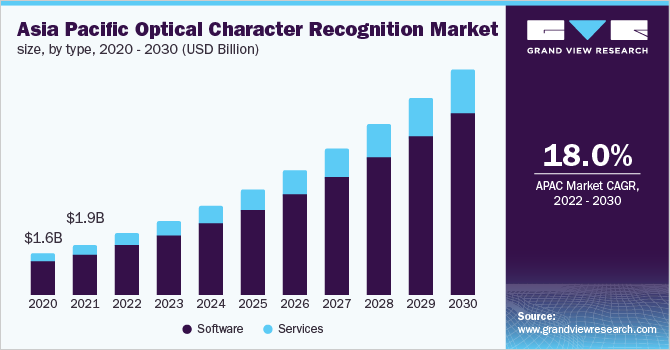
The global optical character recognition market size was valued at USD 8.93 billion in 2021 and is expected to expand at a compound annual growth rate (CAGR) of 15.4% from 2022 to 2030.

The optical character recognition (OCR) technology converts printed and physical documents into machine-readable texts. It extracts scanned papers, image-only pdfs, and camera images and repurposes them. OCR software extracts letters from images and translates them into words and then sentences, allowing access to alter the original text. Moreover, widespread adoption of OCR technology has been observed in BFSI, healthcare, retail, tourism, logistics, transportation, government, manufacturing, and other sectors. The growth of the OCR market is primarily attributed to the improvement in productivity and a rise in the penetration of automatic recognition systems. For instance, in November 2021, HT. KZ, one of the leading travel industries in Kazakhstan, deployed Smart Engine OCR technology that provides document recognition solutions. This technology helps scan its client's passport securely in less than a second through the AI software, which reduces the workload of managers to enter the passport data manually. This solution Combines AI with OCR capabilities.

Gather more insights about the market drivers, restrains and growth of the Global Optical Character Recognition Market

Digitalization in business organizations has made all the processes faster and more accessible. As companies witness technological advancements, data is becoming a critical element for growth. When data is converted to digital form, it can be processed by computers and various devices with computing capacity, and this data is easy to share, access, and store. Companies established before digitalization became a norm in the enterprise sector have also started using tools, such as OCR, to convert their physical data into digital form. The technology also finds increasing application in BFSI and healthcare sectors for creating digital copies of checks, invoices, and other documents. For instance, banks in China utilize OCR software in conjunction with facial recognition software that can protect ATMs as some ATMs require the consumers to input their photo ID, which the program scans for the person’s name and face. They also use OCR software to review the paper applications and other papers that the customer may use to demonstrate responsibility or creditworthiness. Besides, in June 2021, Visionet Systems., a digital solutions provider to the BFSI, launched a new product named DocVu.AI, an AI-powered Intelligent Document Processing. It is a platform for handling a large amount of unstructured and structured data. Banks or financial institutions would easily search, analyze, extract, and manage data sets efficiently. With its AI and machine learning platform, DocVu.AI can meet the needs of the BFSI.

Asia Pacific optical character recognition market size, by type, 2020 - 2030 (USD Billion)

The OCR technology is also being widely used for converting information available in text form into speech with the help of text-to-speech technologies, thus making it accessible to blind and visually impaired individuals. Other applications of the technology include sorting out letters at post offices and documents in law firms and courts, preserving historical and cultural texts, personal identification, and processing invoices, orders, and other documents. For instance, in June 2021, IBM, a U.S.-based company, acquired Turbonomic, an AI-powered application. This acquisition is expected to use AI through machine learning, natural language processing, and optical character recognition.

Numerous benefits of optical character recognition technology have helped companies save time spent on entering data manually in computers, enhancing work management, reducing the cost of converting documents into digital form, and reducing manual errors, among others. It also offers other benefits such as improved customer service and increased documents security, significantly propelling demand across industries, including BFSI and retail. The increased focus of cognitive solution developers on integrating advanced technologies to improve accuracy is also expected to significantly drive the market in the near future. For instance, Envision, a smartphone app that helps blind and low vision users, introduced AI-powered smart glasses helping visually impaired and blind users to have hands-free access and make everyday life more accessible. These smart glasses will have optical character recognition capability.

Browse through Grand View Research's Next Generation Technologies Industry Related Reports

  • Machine Learning Market - The global machine learning market size was valued at USD 6.9 billion in 2018 and is anticipated to register a CAGR of 43.8% from 2019 to 2025. Emerging technologies such as artificial intelligence are changing the way industries and humans work.
  • Augmented Reality Market - The global augmented reality market size was estimated at USD 25.33 billion in 2021 and is expected to expand at a compound annual growth rate (CAGR) of 40.9% from 2022 to 2030.

Market Share Insights

December 2021: Adobe, a computer software company, partnered with Microsoft, a U.S.-based tech giant. This partnership will help enterprises enable their customer experience with Microsoft Azure, Adobe Experience Cloud, and Microsoft Dynamics.

April 2021: Microsoft acquired Nuance Communications, an AI and speech recognition-based company, and this acquisition would increase the presence of Microsoft cloud for healthcare.

Key Companies profiled:

Some prominent players in the global Optical Character Recognition market include

  • ABBYY
  • Adobe
  • Anyline GmbH
  • ATAPY Software
  • Captricity Inc.
  • Creaceed S.P.R.L.
  • CVISION Technologies, Inc.
  • Exper-OCR, Inc.
  • Google LLC
  • International Business Machines Corporation
  • IntSig Information Co., Ltd. Corporation
  • IRIS S.A.
  • LEAD Technologies, Inc.
  • Microsoft
  • NAVER Corp.
  • Nuance Communications, Inc.
  • Open Text Corporation

Order a free sample PDF of the Optical Character Recognition Market Intelligence Study, published by Grand View Research.
Material Handling Equipment Market Revenue To Surpass $44.5 Billion By 2028

Material Handling Equipment Industry Overview

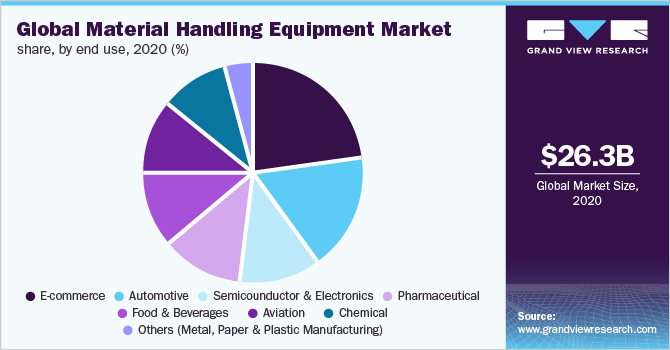
The global material handling equipment market size was valued at USD 26.3 billion in 2020 and is expected to expand at a compound annual growth rate (CAGR) of 7.4% from 2021 to 2028.

Over 50.0% of factory owners estimate that new projects will either be delayed or put on hold because of the coronavirus pandemic. In comparison, close to 30.0% of owners expect to adjust the sales revenue with the ongoing projects. The mentioned statistics do not bode well for the growth of the market unless OEMs aim to transform digitally. Investments in power and battery technology are expected to create avenues for market growth.

Gather more insights about the market drivers, restrains and growth of the Global Material Handling Equipment Market

Apart from the uncertainties created by the coronavirus pandemic, favorable government initiatives support new infrastructure development worldwide, creating growth opportunities in the market for material handling equipment over the forecast period. Economies such as India, China, and Southeast Asia are attracting foreign investments promoting infrastructure and industrial development, subsequently creating avenues for growth. The development of public infrastructure includes airports, rail networks, seaports and power plants, and others. All these activities may favor the adoption of material handling equipment over the forecast period.

Although the demand in industrial applications witnessed a minor setback in 2020, unprecedented growth in the e-commerce sector helped upkeep market growth through the pandemic. Healthy demand for delivery and distribution of grocery items amidst the lockdown came as a respite for market growth. In addition to the OEMs, the pandemic has driven several supply chain firms to explore tools that aid in making informed decisions with AI implementation to analyze large amounts of data they generate periodically. A combination of data-driven insights and hindsight will help build a resilient supply chain supported by advances in equipment technology.

Global material handling equipment market share, by end use, 2020 (%)

The development of the One Belt One Route (OBOR) initiative by China, also known as the Belt and Road Initiative (BRI), is also expected to be lucrative for the materials handling equipment industry. The initiative to connect a network of rail and road routes from China to Europe via the Middle East will provide growth opportunities. Similar other initiatives will bode well for the material handling equipment industry over the next few years.

The 2021 Automation Solutions Survey Study stated that the COVID-19 pandemic triggered the demand for a fully automated solution in the manufacturing sector, with companies increasing investments in automated solutions over the next few years. Further, companies project to upgrade their conveyor and sortation system in the next two years. However, due to the pandemic, several medium-sized businesses have altered plans to purchase or modernize new equipment.

Browse through Grand View Research's Advanced Interior Materials Industry Related Reports

  • Automated Guided Vehicle Market - The global automated guided vehicle market size was valued at USD 3.81 billion in 2021 and is expected to expand at a compound annual growth rate (CAGR) of 10.2% from 2022 to 2030. Automated guided vehicle (AGV) systems assist to move and transport items in manufacturing facilities, warehouses, and distribution centers without any permanent conveying system or manual intervention.
  • Material Handling Equipment Telematics Market - The global material handling equipment telematics market size was valued at USD 3.18 billion in 2017. It is expected to expand at a CAGR of 11.7% during the forecast period. The industry has witnessed significant developments in the past few years.

Material Handling Equipment Market Segmentation

Grand View Research has segmented the global material handling equipment market based on product, end use, and region:

  • Material Handling Equipment Product Outlook (Revenue, USD Billion, 2017 - 2028)
    • Storage and Handling Equipment
    • Automated Storage and Retrieval System
    • Industrial Trucks
    • Bulk Material Handling Equipment
    • Others
  • Material Handling Equipment End use Outlook (Revenue, USD Billion, 2017 - 2028)
    • Automotive
    • Food & Beverages
    • Chemical
    • Semiconductor & Electronics
    • E-commerce
    • Aviation
    • Pharmaceutical
    • Others
  • Material Handling Equipment Regional Outlook (Revenue, USD Million, 2017 - 2030)
    • North America
    • Europe
    • Asia Pacific
    • Latin America
    • Middle East & Africa

Market Share Insights

  • April 2021: Toyota Material Handling, one of the subsidiaries of Toyota Industries Corporation, launched Mole and Mouse Automated Guided Carts (AGCs). The product is expected to allow customers to automate repetitive operational tasks suitable for assembly lines, distribution centers, warehouses, and manufacturing plants.
  • July 2020: Vanderlande Industries B.V, one of the logistics process automation providers, introduced HOMEPICK, a goods-to-person (GtP) picking solution. The product complements its automated storage and retrieval system (AS/RS) and facilitates online grocery orders.

Key Companies profiled:

Some prominent players in the global Material Handling Equipment market include

  • BEUMER Group
  • Daifuku Co., Ltd.
  • Honeywell International Inc.
  • Kion Group AG
  • Mecalux, S.A
  • Murata Machinery Ltd.
  • SSI Schaefer AG
  • Swisslog Holding AG
  • Toyota Material Handling Group
  • Vanderlande Industries B.V

 Order a free sample PDF of the Material Handling Equipment Market Intelligence Study, published by Grand View Research.
Filters Market Growth Is Driven By The Rapidly Increasing Adoption Of Air Purifiers In Homes

Filters Industry Overview

The global filters market size was estimated at USD 72.33 billion in 2021 and is expected to grow at a compounded annual growth rate (CAGR) of 5.1% from 2022 to 2030.

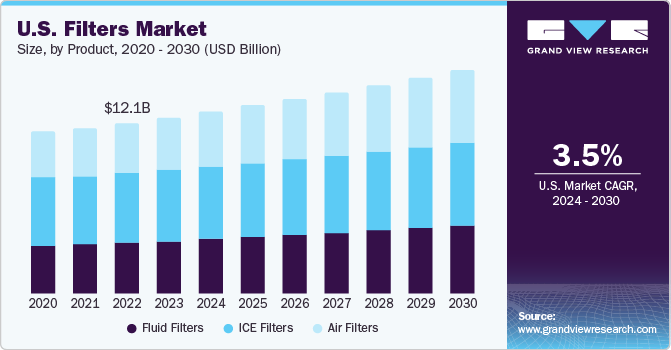
Growing emphasis on the reduction of emissions from automotive and industrial applications is expected to drive market growth over the forecast period. An increase in product usage in several consumer goods, such as air and water purifiers, is expected to have a positive impact on the industry growth. The rapidly growing adoption of air purifiers in homes, hotels, restaurants, airplanes, and train compartments for killing harmful microbes, such as bacteria and viruses, is expected to open new opportunities for market growth.

Gather more insights about the market drivers, restrains and growth of the Global Filters Market

The market in the U.S. is expected to exhibit high growth on account of factors rising product demand from the automotive industries as per the environmental regulations laid down by the Environmental Protection Agency (EPA) for the installation of air emission control solutions in vehicles. In addition, economic revival and government initiatives to promote environmental protection are expected to drive market growth in the country. The global market growth is also credited to the increasing focus of the government on water treatment schemes for the construction of water treatment facilities due to factors, such as the scarcity of quality drinking water, growing population, and contamination of ground and surface water bodies.

U.S. filters market size, by product, 2020 - 2030 (USD Billion)

The industry is significantly affected by the availability of raw materials, such as paper, cotton, synthetic textiles & fibers, metals like iron & steel, adhesives, rubber, chemicals, and plastics. Thus, the fluctuations in the raw material prices have a direct impact on the manufacturing costs that limits the industry growth to some extent. The market growth is also expected to be driven by the rise in the global automotive industry on account of the growing population and increasing disposable income levels, especially in the developing regions, such as Asia Pacific, Middle East & Africa, and Central & South America. Filters are used in several applications in the automotive industry, such as oil intake, cabin air filtration, and emission filtration.

Browse through Grand View Research's Advanced Interior Materials Industry Related Reports

  • Automotive Air Filters Market - The global automotive air filters market size was valued at USD 3.9 billion in 2018, exhibiting a CAGR of 4.8% over the forecast period. Rising product demand from the automotive industry owing to stringent government regulations for vehicle emission is estimated to fuel the market growth over the forecast period.
  • Industrial Air Filtration Market - The global industrial air filtration market size was valued at USD 10.4 billion in 2019 and is expected to register a CAGR of 7.3% from 2020 to 2027. The need to control industrial air quality across a range of end use industries is a key factor anticipated to drive market growth over the forecast period.

Filters Market Segmentation

Grand View Research has segmented the global filters market on the basis of product, application, and region:

  • Filters Product Outlook (Revenue, USD Million, 2017 - 2030)
    • Fluid Filters
    • ICE Filters
    • Air Filters
  • Filters Application Outlook (Revenue, USD Million, 2017 - 2030)
    • Motor Vehicle
    • Consumers Goods
    • Utilities
    • Industrial & Manufacturing
    • Others
  • Filters Regional Outlook (Revenue, USD Million, 2017 - 2030)
    • North America
    • Europe
    • Asia Pacific
    • Latin & South America
    • Middle East & Africa

Market Share Insights

September 2020: PURAFIL, INC. installed portable filtration systems called “PuraShield Smart 1000” to improve indoor air quality for Northwestern University Athletics & Recreation.

April 2020: HEPA Filter produced by Ford is being shared by MANN+HUMMEL and its subsidiary Tri-Dim Filter Corporation. These Filters helps to remove germs and viruses from the supply air.

Key Companies profiled:

Some prominent players in the global Filters market include

  • 3M
  • Airex Filter Corporation
  • Koch Filter
  • Freudenberg Filtration Technologies SE & Co. KG
  • Donaldson Company, Inc.
  • Camfil AB
  • Parker Hannifin Corp.
  • DENSO Corp.
  • Clark Air Systems
  • Spectrum Filtration Pvt. Ltd.

Order a free sample PDF of the Filters Market Intelligence Study, published by Grand View Research.
Which Segment Accounted For The Largest Petrochemicals Market Share?

Petrochemicals Industry Overview

The global petrochemicals market size was valued at USD 556.09 billion in 2021 and is expected to expand at a compound annual growth rate (CAGR) of 6.2% from 2022 to 2030.

The demand for petrochemicals is attributed to an increase in the demand for downstream products from various end-use industries such as construction, pharmaceuticals, and automotive, which is a major factor driving the market. Petrochemical is a vital component for many industrial processes, and hence forms the backbone of an industrial economy. Some of the products derived from petrochemicals include tires, industrial oil, detergents, and plastics. Basic plastic derived from the product act as a building block in the manufacturing of consumer goods.

Gather more insights about the market drivers, restrains and growth of the Global Petrochemicals Market

End-use industries evaluate the quality of products supplied from time to time and establish procurement agreements with suppliers to purchase petrochemicals derivatives in bulk and ensure their stable and seasonal supply. An increasing number of product suppliers in the market has resulted in the high bargaining power of the buyers.

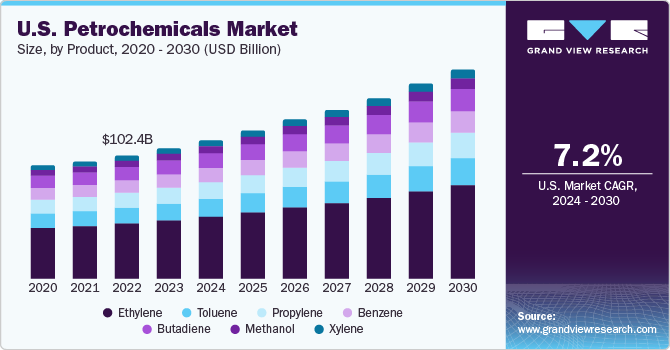
U.S. petrochemicals market size, by product, 2020 - 2030 (USD Billion)

The industry is significantly affected by the prices of crude oil as it is a basic raw material used for the manufacturing of the product. The volatility in the prices and supply of crude oil has affected the production cost of petrochemicals, which, in turn, makes their production process costly. Factors such as the growing inclination of consumers in the developed and developing regions toward environment-friendly products and the volatile prices of raw materials of petrochemicals are likely to hamper the market growth in the coming years.

The steam cracking process is one of the most commonly used processes for manufacturing petrochemicals from natural gas or crude oil. In this process, ethane, a derivative of natural gas or naphtha that is predominantly derived from crude oil, is used for the manufacturing of olefins. A steam cracker has equipment operating at pressure from near-vacuum to 100 atm and operating at temperatures from 100 K to 1400 K.

Browse through Grand View Research's Bulk Chemicals Industry Related Reports

  • Methanol Market - The global methanol market size was estimated at USD 31.81 billion in 2018 and is projected to accelerate at a CAGR of 2.9% from 2019 to 2025. Increasing consumption of methanol for the production of dimethyl ether and Methyl tert-butyl ether (MTBE), utilized as the alternatives for gasoline, is expected to propel the growth.
  • Acetic Acid Market - The global acetic acid market size was valued at USD 8.92 billion in 2019 and is expected to grow at a compound annual growth rate (CAGR) of 5.2% from 2020 to 2027. Rising demand for the product from Vinyl Acetate Monomer (VAM) producers worldwide is projected to remain a key driving factor for the market growth.

Petrochemicals Market Segmentation

Grand View Research has segmented the global petrochemicals market on the basis of product and region:

  • Petrochemicals Product Outlook (Volume, Million Tons; Revenue, USD Billion, 2018 - 2030)
    • Ethylene
    • Propylene
    • Butadiene
    • Benzene
    • Xylene
    • Toluene
    • Methanol
  • Petrochemicals Regional Outlook (Revenue, USD Million, 2017 - 2030)
    • North America
    • Europe
    • Asia Pacific
    • Latin America
    • Middle East
    • Africa

Market Share Insights

Jan 2021: LyondellBasell and Sinopec finalize joint venture to manufacture propylene oxide and styrene monomer in China.

August 2019: China National Petroleum Corporation signed an agreement with the Republic of Benin to construct a pipeline from Niger to the Atlantic coast in Benin to strengthen its crude oil business footprint in Africa.

Key Companies profiled:

Some prominent players in the global Petrochemicals market include

  • BASF SE
  • Chevron Corporation
  • China National Petroleum Corporation (CNPC)
  • China Petrochemical Corporation
  • Exxon Group Ltd.
  • INEOS Group Ltd.
  • LyondellBasell Industries Holdings B.V.
  • Royal Dutch Shell PLC

Order a free sample PDF of the Petrochemicals Market Intelligence Study, published by Grand View Research.
The Increasing Demand For Semiconductor Production Equipment Will Drive The Computer Numerical Control Machines Market Growth

Computer Numerical Control Machines Industry Overview

The global computer numerical control machines market size was valued at USD 56.40 billion in 2021 and is expected to expand a compound annual growth rate (CAGR) of 10.2% from 2022 to 2030.

The demand for computer numerical control (CNC) machines is estimated to reach over 2800 thousand units by 2030. The increasing demand for semiconductor production equipment, medical devices and Electric Vehicles (EV), and telecom communication devices is the primary factor expected to drive the market growth over the forecast period. Also, the growing demand for five-axis mill machines and ultra-precision machines required to address the needs for EV productions are anticipated to drive the growth.

Gather more insights about the market drivers, restrains and growth of the Global Computer Numerical Control Machines Market

The CNC machine market recovered well in 2021 due to increased machine orders across the industries, notably from Europe, Asia Pacific, and North America. In 2021, the market recorded positive growth owing to the pent-up demand and backlog orders resulting from the pandemic. This trend will continue over the short term to meet backlogs from 2020. However, the worldwide shortage of semiconductors and rising steel prices & logistics costs are expected to hinder the sales revenues of OEMs, a trend that is expected to continue till 2023.

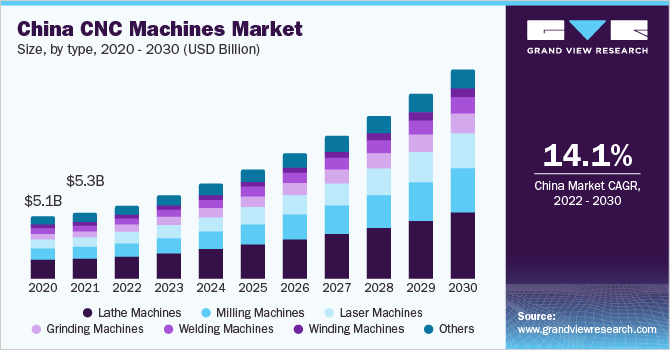
China CNC Machines Market Size, by Type, 2020 - 2030 (USD Billion)

Automated CNC systems integrated with industrial robots featuring simulation software to increase production is expected to favor the growth of the Computer Numerical Control (CNC) machines market over the forecast period. One of the primary reasons for adopting automated CNC machines is to address the lack of skilled laborers challenges that most industries are currently facing. This enables manufacturing industries to increase their efficiency and maximize the production output. To address this demand, incumbents in this space, such as Fanuc Corporation and OKAMA America Corporation, emphasize integrating new technologies with the existing product portfolio.

For instance, in March 2021, Fanuc America Corporation, a subsidiary of Fanuc Corporation, upgraded its CNC product portfolio by integrating the Quick and Simple Startup of Robotization (QSSR) G-code feature with ss. The company provides enhanced CNC machines that machine operators and tool builders to program the robots more efficiently through this integration. Similarly, in August 2021, Made4CNC ApS, one of the CNC manufacturers based in Denmark, launched a new Safedoor SD100, an automated door opener for CNC machines. The product integrates easily with collaborative robots and offers greater convenience for tending machine operations.

Rising raw material prices and a looming shortage of semiconductors used in CNC machines are expected to pose challenges for the market. In such market conditions, the demand for used CNC machines is expected to increase, hampering the market growth of new CNC machines. The trend is likely to continue over the forecast period. In the long term, the average unit prices of CNC machines are expected to increase with fluctuations in raw material prices.

Browse through Grand View Research's Advanced Interior Materials Related Reports

  • Milling Machine Market - The global milling machine market size was valued at USD 63,156.5 million in 2018 and is expected to register a CAGR of 7.0% from 2019 to 2025. Milling machines are some of the most important machines used in metal cutting applications across several industries.
  • Welding Equipment Market - The global welding equipment market size was valued at USD 11.53 billion in 2018 and is expected to register a CAGR of 6.9% from 2019 to 2025. The market has witnessed considerable growth over the past years owing to the growing demand for welding equipment across applications such as shipbuilding, offshore exploration, oil & gas, aerospace, automotive, construction, and energy.

Computer Numerical Control Machines Market Segmentation

Grand View Research has segmented the global computer numerical control machines market based on type, end-use, and region:

  • CNC Machines Type Outlook (Volume, Thousand Units; Revenue, USD Billion, 2018 - 2030)
    • Lathe Machines
    • Milling Machines
    • Laser Machines
    • Grinding Machines
    • Welding Machines
    • Winding Machines
    • Others
  • CNC Machines End-use Outlook (Revenue, USD Billion, 2018 - 2030)
    • Automotive
    • Aerospace & Defense
    • Construction Equipment
    • Power & Energy
    • Industrial
    • Others
  • CNC Machines Regional Outlook (Revenue, USD Million, 2017 - 2030)
    • North America
    • Europe
    • Asia Pacific
    • Latin America
    • Middle East & Africa

Market Share Insights

August 2021: Made4CNC ApS, one of the CNC manufacturers based in Denmark, launched a new Safedoor SD100, an automated door opener for CNC machines. The product integrates easily with collaborative robots and offers greater convenience for tending machine operations.

February 2021: Citizen Machinery Co., Ltd launched Cincom L32 XII, a Sliding Headstock Type Automatic CNC Lathe machine that features an automatic tool changer. The features enable to perform complex shapes machining such as implants used in medical treatment and perform multiple functions simultaneously.

Key Companies profiled:

Some prominent players in the global Computer Numerical Control Machines market include

  • Amada Co., Ltd.
  • Amera Seiki
  • Fanuc Corporation
  • Datron AG
  • DMG Mori
  • Dalian Machine Tool Group (DMTG) Corporation
  • Haas Automation, Inc.
  • Okuma Corporation
  • Shenyang Machine Tool Co., Ltd. (SMTCL)
  • Hurco Companies, Inc.
  • Yamazaki Mazak Corporation

Order a free sample PDF of the Computer Numerical Control Machines Market Intelligence Study, published by Grand View Research.
What Are The Factors Driving The Revenue To Fire Alarm And Detection Market?

Fire Alarm And Detection Industry Overview

The global fire alarm and detection market size was valued at USD 29.75 billion in 2021 and is expected to expand at a compound annual growth rate (CAGR) of 7.2% from 2022 to 2030.

The demand for advanced fire safety systems in fire-prone industrial settings, such as automotive, power & utility, mining, petrochemical, and oil & gas exploration, will drive the market growth over the next seven years. Fire safety amidst the newly minted work-from-home model in light of the COVID-19 pandemic has gained prominence. With businesses slowly reopening in some parts of the world, building managers or facility owners are securing and maintaining fire protection systems.

Gather more insights about the market drivers, restrains and growth of the Global Fire Alarm And Detection Market

The reassessment of fire safety requirements will create growth opportunities for market players over the coming years. The need for fire safety solutions surged marginally in 2021. However, due to supply chain disruptions, vendors in this space witnessed minor hiccups in receiving and fulfilling orders. Given the current scenario, the demand for cooking fire safety, electrical fire safety, and heater fire safety will gain traction over the next few years. The global market will most likely reach pre-COVID levels by the end of 2021. The market is already on its path to recovery with a minor setback caused by supply chain disruptions.

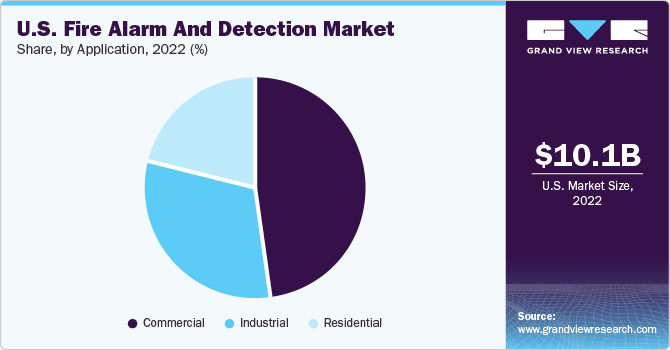
U.S. fire alarm and detection market size, by product, 2020 - 2030 (USD Million)

However, as businesses reopen, the importance of fire safety is likely to take center stage and will drive product sales over the next few years. In addition, the pandemic-induced work-from-home model will also contribute to industry recovery as fire safety gains prominence with individuals spending considerable time working from home. As the industry continues to witness a modest upsurge led by the pandemic, a recovery in construction-related projects, both new and redevelopment, will also generate lucrative market conditions for the fire safety OEMs.

Although a large number of projects have taken a backseat for the mid-term, opportunities still thrive in terms of anticipated new projects and ongoing projects that will resume in 2021. Fire detection & alarm is are integral elements of any building project enabling safety across several structures. Hence, a rise in the number of construction-related projects will come as a respite for the industry’s growth. In addition, advancements in technology enabling wireless products with improvements in response time will also pave the way for future growth.

Browse through Grand View Research's Advanced Interior Materials Related Reports

  • Fire-resistant Glass Market - The global fire-resistant glass market size was valued at USD 4.25 billion in 2020 and is expected to grow at a compound annual growth rate (CAGR) of 4.3% from 2021 to 2028. The rising number of fire accidents coupled with expansion in the construction industry is anticipated to augment the market growth over the forecast period.
  • Fire Protection System Market - The global fire protection system market size was valued at USD 72.72 billion in 2021 and is expected to expand at a compound annual growth rate (CAGR) of 6.7% from 2022 to 2030. In 2020, the outbreak of the COVID-19 pandemic negatively impacted the market.

Fire Alarm And Detection Market Segmentation

Grand View Research has segmented the global fire alarm and detection market on the basis of product, fire detectors type, fire alarm type, application, and region:

  • Fire Alarm & Detection Product Outlook (Revenue, USD Million, 2017 - 2030)
    • Fire Detectors
    • Fire Alarms
  • Fire Alarm & Detection Fire Detector Type Outlook (Revenue, USD Million, 2017 - 2030)
    • Flame Detectors
    • Smoke Detectors
    • Heat Detectors
  • Fire Alarm & Detection Fire Alarm Type Outlook (Revenue, USD Million, 2017 - 2030)
    • Audible
    • Visual
    • Manual Call-points
  • Fire Alarm & Detection Application Outlook (Revenue, USD Million, 2017 - 2030)
    • Commercial
    • Industrial
    • Residential
  • Fire Alarm And Detection Regional Outlook (Revenue, USD Million, 2017 - 2030)
    • North America
    • Europe
    • Asia Pacific
    • Latin America
    • Middle East & Africa

Market Share Insights

March 2020: Napco Security unveiled iSecure a Complete Cellular Alarm Systems. It is designed to help security professionals to be more competitive, adding more residential accounts and new RMR, while offering the professional-grade security systems, remote Smart App & notification alerts.

May 2019: Kiddelaunched the new Kidde smoke alarms. These alarms have been designed for reducing the common cooking nuisance alarms and responding faster to different types of fire.

Key Companies profiled:

Some prominent players in the global Fire Alarm And Detection market include

  • Johnson Controls International plc
  • Honeywell International, Inc.
  • Napco Security Technologies, Inc.
  • Nittan Co., Ltd.
  • Siemens AG
  • Halma plc
  • United Technologies Corp.
  • Robert Bosch GmbH
  • Eaton Corp.

Order a free sample PDF of the Fire Alarm And Detection Market Intelligence Study, published by Grand View Research.

How Big Is The Horizontal Directional Drilling Market?

Horizontal Directional Drilling Industry Overview

The global horizontal directional drilling market size was valued at USD 8.16 billion in 2020 and is expected to expand at a compound annual growth rate (CAGR) of 6.7% from 2021 to 2028.

The Horizontal Directional Drilling (HDD) technique is used to accurately undertake drilling operations and back ream the required pipe, sidelining various obstacles on the bore path without causing significant collateral damage to the subsurface ecosystems. Rising concerns about the need to minimalize environmental damage caused by rapid infrastructure development across the globe worldwide are contributing significantly to the increased adoption of horizontal directional drilling. Growing utility installations, burgeoning investments in shale gas development projects, and rising expenditures aimed at various developments across the telecom sector to offer high-speed connectivity are some of the other factors contributing to market growth.

Gather more insights about the market drivers, restrains and growth of the Global Horizontal Directional Drilling Market

Over the past few years, the horizontal directional drilling technique has emerged as one of the most popular trenchless drilling technologies. This horizontal boring method requires fewer boreholes to be drilled and maintained. Growth prospects of the industry are subject to heavy investments as the equipment needed for trenchless boring costs much higher than conventional open-cut methods. As the setups are costly, customers opt to rent out the entire setup from contractors. Furthermore, various mid-sized companies also hire service providers for end-to-end projects. As a result, both horizontal directional drilling machine manufacturers and service providers hold a strong position in the market.

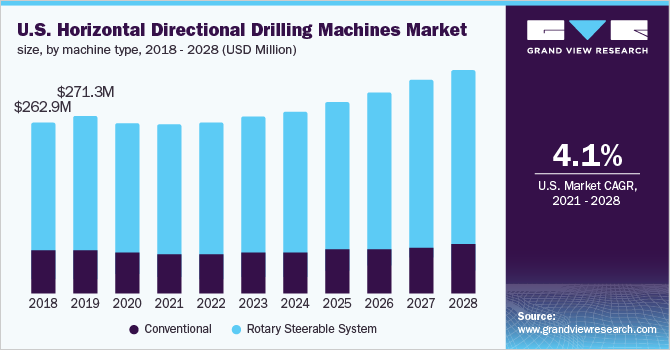
U.S. horizontal directional drilling machines market size, by machine type, 2018 - 2028 (USD Million)

Since its inception, the horizontal trenchless technique has gained significant traction owing to its deployment from a single location in extremely rough sub-surface and the ability to hit multiple target zones. The prevalence of disruptive digital technologies, including 3D visualization, 3D earth models, and automation, has led to faster implementation, reduced noise and waste, and enhanced underground accessibility. Additionally, these technologies have enabled engineers, geoscientists, and other related personnel to more accurately visualize and optimize the Rate of Penetration (ROP) of the bore path. Technological advancements have also played a major role in helping the horizontal trenchless technique achieve a prominent position in drilling applications across oilfields, renewable gas exploration, and long-distance optical fiber installations in offshore locations.

Horizontal directional drilling is primarily employed for applications such as the installation of electrical conductors, utility transmission and supply lines, and communication conduits and cables. The cross bore technique that enables the intersection of two or more pipelines underneath the surface poses a threat to these directional boring industry workers and the public. This may be attributed to the lack of visibility in determining the track of the drilling activities in sub-surface locations. The cross-bore intersection of various utilities can often result in explosions, resulting in injuries and death. To avoid this, Occupational Safety and Health Administration (OSHA) mandates directional boring operators to check for structures indicating subversive utility installations or any other obstructions along the drill path before physically drilling entry and exit holes in the required locations. Apart from this, the market is also subjected to various environmental norms that emphasize reducing the ecological impact during underground construction activities.

The COVID-19 pandemic resulted in a temporary shutdown of horizontal directional drilling activities at several sites in a range of industries owing to stringent government lockdown regulations to arrest the spread of the disease. The oilfield sector faced major operational concerns as companies temporarily halted upstream and downstream activities, resulting in the abrupt decline in oil and gas production. Furthermore, oil prices dropped owing to a significant reduction in the frequency of transportation worldwide on the heels of a price war among the U.S., Saudi Arabia, and Russia. As a result, incumbents of horizontal directional services and the machine industry faced a downturn in demand. However, continual measures taken by world governments for mitigating the impact of the pandemic on oil and gas exploration companies are expected to allow for recovery in the horizontal directional drilling market in the near future.

Browse through Grand View Research's Advanced Materials Related Reports

  • Drilling Fluids Market - The global drilling fluids market size was valued at USD 8.0 billion in 2019 and is projected to register a CAGR of 4.2% from 2020 to 2027. Growing demand for crude oil and natural gas in various energy-intensive industries such as power generation, manufacturing, and transportation has urged exploration and production companies to increase their investments in onshore and offshore drilling activities.
  • Mining Drills & Breakers Market - The global mining drills & breakers market size was valued at USD 8.04 billion in 2016. The increasing mineral exploration activities are expected to drive market growth over the next nine years, owing to the presence of several mineral reserves, particularly in China, India, and Australia.

Market Share Insights

November 2019: The Charles Machine Works Inc. Company announced the launch of the ride-on trencher, RT80, with a tier-4, 74.5-horsepower diesel engine. The trencher is targeted toward urban utility job sites.

April 2018: UEA was appointed by Telstra Corporation Limited, an Australia-based Telecommunications Company, to install directional bore telecommunications works for the Indigo-West cable system between Singapore and Perth.

Key Companies profiled:

Some prominent players in the global Horizontal Directional Drilling market include

  • Nabors Industries Ltd.
  • The Toro Company
  • The Charles Machine Works, Inc.
  • Vermeer Corporation
  • Herrenknecht AG
  • XCMG

Order a free sample PDF of the Horizontal Directional Drilling Market Intelligence Study, published by Grand View Research.

Endobronchial Ultrasound Biopsy Market Gains Momentum with Minimally Invasive Innovations

The global Endobronchial Ultrasound Biopsy Market is experiencing significant growth as healthcare providers increasingly adopt minimally i...