The global forklift market was estimated at USD 81.44 billion in 2025 and is projected to reach USD 212.63 billion by 2033, expanding at a strong CAGR of 12.7% from 2026 to 2033. Market growth is being driven by the rapid shift toward electric forklifts, increasing adoption of automation and autonomous material-handling solutions, and rising demand from the e-commerce, logistics, and warehousing sectors.
The forklift industry is undergoing a significant transition from diesel- and LPG-powered equipment to electric models. This shift is supported by stricter emissions regulations, rising fossil fuel costs, and a growing emphasis on sustainability and cleaner workplace environments. Modern lithium-ion electric forklifts offer key advantages such as lower maintenance requirements, reduced downtime, and longer operating cycles compared to traditional internal combustion and lead-acid battery-powered forklifts. As warehouses and manufacturing facilities prioritize quiet, emission-free operations, electric forklifts are increasingly becoming the preferred choice and are expected to dominate future fleet replacement cycles globally.
Automation is transforming material-handling operations, with autonomous forklifts emerging as a major growth area within the market. These systems leverage advanced technologies such as sensors, LiDAR, cameras, and intelligent navigation software to operate with minimal human intervention. Persistent labor shortages in warehousing, coupled with the need for higher accuracy, improved safety, and 24/7 operational capability, are accelerating adoption. Autonomous forklifts help reduce operational errors, improve throughput during peak demand, and enhance overall efficiency. Over the coming decade, semi-autonomous and fully autonomous forklifts are expected to become standard equipment in large-scale distribution centers and manufacturing facilities.
Key Market Trends & Insights
- Asia Pacific dominated the global forklift market, accounting for a revenue share of 49.0% in 2025.
- By class, the class 3 segment led the market with the largest share of 45.3% in 2025.
- By power source, electric forklifts dominated the market in 2025, reflecting the industry’s shift toward sustainable solutions.
- By load capacity, the 5–15 ton segment accounted for the largest market share in 2025.
- By electric battery type, the lead-acid segment held the dominant position in 2025.
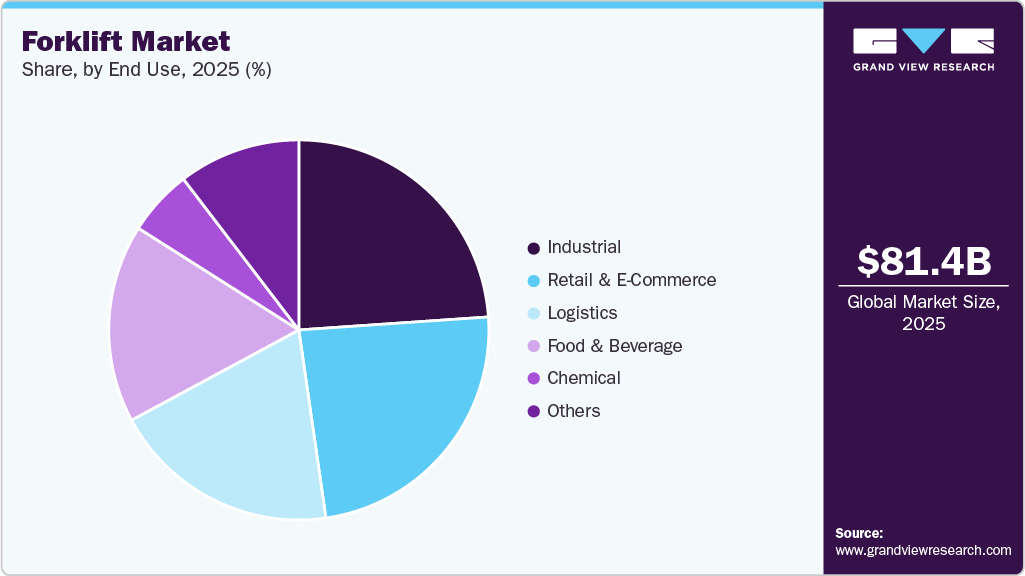
- By end use, the industrial segment generated the highest revenue share in 2025.
Download a free sample PDF of the Forklift Market Intelligence Study by Grand View Research.
Market Size & Forecast
- 2025 Market Size: USD 81.44 Billion
- 2033 Projected Market Size: USD 212.63 Billion
- CAGR (2026–2033): 12.7%
- Largest Regional Market (2025): Asia Pacific
Competitive Landscape
The competitive landscape is characterized by continuous product innovation, a strong focus on electrification, and the integration of advanced battery technologies.
- In December 2025, Clark Material Handling Company unveiled its S25–35XE Renegade Lithium Series, a new range of electric forklifts with lifting capacities of 5,000, 6,000, and 7,000 lbs, designed to meet growing demand for high-performance electric material-handling equipment.
- In November 2025, Bobcat launched its first 3-wheel electric forklift range, the B16–20-NT series. Featuring advanced lithium-ion technology, compact design, and zero-emission operation, the new models are optimized for light to medium-duty applications and efficient performance in confined spaces.
Key Companies in the Global Forklift Market
- Anhui Heli Co., Ltd.
- Clark Material Handling Company
- Crown Equipment Corporation
- Doosan Corporation
- Hangcha Forklift
- Hyster-Yale Materials Handling, Inc.
- Jungheinrich AG
- KION Group AG
- Komatsu Ltd.
- Mitsubishi Logisnext Co., Ltd.
- Toyota Motor Corporation (Toyota Material Handling)
Explore Horizon Databook – the world’s most comprehensive market intelligence platform by Grand View Research.
Conclusion
The global forklift market is poised for strong and sustained growth, driven by electrification, automation, and expanding logistics and e-commerce infrastructure. As sustainability goals, labor challenges, and efficiency requirements continue to shape material-handling strategies, manufacturers that focus on electric, autonomous, and technologically advanced forklift solutions are expected to gain a competitive edge in the evolving global market.

No comments:
Post a Comment