The global smart home security camera market was valued at USD 9.98 billion in 2024 and is projected to reach USD 56.47 billion by 2033, growing at a strong CAGR of 21.7% from 2025 to 2033. The expanding need for safer residential environments and reliable surveillance solutions is driving consistent growth across the global smart home security landscape.
Consumers are increasingly adopting smart security cameras due to their ease of use, remote accessibility, and advanced feature sets. The rapid integration of these devices within broader smart home ecosystems—enabled by the expansion of IoT technologies—is accelerating market penetration. Rising awareness around home security, coupled with the growing demand for real-time and remote monitoring solutions, continues to strengthen adoption rates worldwide.
Ongoing advancements in artificial intelligence (AI) and machine learning are significantly enhancing the performance and appeal of smart home security cameras. Features such as intelligent motion detection, facial recognition, anomaly alerts, and edge-based data processing are redefining user expectations.
In January 2025, Xthings Inc. introduced its new Ulticam home security cameras featuring edge AI technology and subscription-free cloud storage. These cameras are designed to deliver enhanced security capabilities without recurring fees, addressing one of the key consumer concerns associated with smart surveillance systems.
The increase in thefts and break-ins, particularly in urban areas, is prompting homeowners and small businesses to seek smarter, more proactive security solutions. Smart security cameras are becoming a preferred choice due to their ability to provide live monitoring, real-time alerts, and visual evidence, while also acting as a deterrent to criminal activity.
According to SafeHome.org, published in February 2025, approximately 26% of U.S. consumers considered purchasing a home security camera. This growing interest highlights a broader shift toward preventive security measures and technology-driven protection.
Key Market Trends & Insights
- North America dominated the global smart home security camera market in 2024, accounting for 41.1% of total revenue
- Asia Pacific is witnessing rapid expansion and is projected to grow at a CAGR of 22.9%
- By technology, wired smart home security cameras held the largest share at 51.0%
- Wireless smart home security cameras are the fastest-growing segment, with a projected CAGR of 23.3%
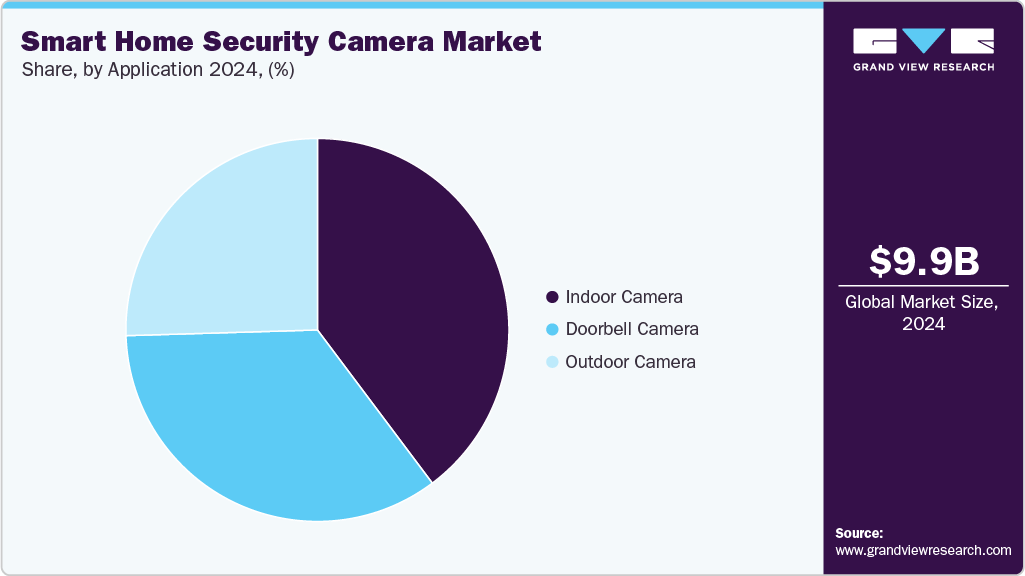
- Smart indoor cameras accounted for 39.8% of market revenue in 2024
Download a free sample PDF of the Smart Home Security Camera Market Intelligence Study by Grand View Research.
Market Size & Forecast
- 2024 Market Size: USD 9.98 Billion
- 2033 Projected Market Size: USD 56.47 Billion
- CAGR (2025–2033): 21.7%
- North America: Largest market in 2024
- Asia Pacific: Fastest-growing market
Competitive Landscape
The competitive environment is marked by strategic partnerships and feature-driven product enhancements aimed at improving security effectiveness and user experience.
In November 2024, Sensormatic Solutions, a global retail solutions brand under Johnson Controls, partnered with Thruvision to enhance people screening capabilities in retail environments. The collaboration integrates passive terahertz camera technology that enables detection of concealed items from distances of up to seven meters, without emitting radiation or compromising privacy.
In October 2024, Ring LLC introduced 24/7 continuous recording across its security camera lineup, allowing uninterrupted video capture rather than motion-triggered recording only—significantly expanding surveillance coverage.
Key Players Include
- Vivint Smart Home, Inc.
- ADT Inc.
- SimpliSafe, Inc.
- Brinks Home Security
- Xiaomi Inc.
- Skylinkhome
- Samsung Electronics Co., Ltd.
- Frontpoint Security Solution, LLC
- Arlo Technologies, Inc.
Explore Horizon Databook – the world’s most comprehensive market intelligence platform by Grand View Research.
Conclusion
The smart home security camera market is set for exceptional growth through 2033, driven by increasing security concerns, rising urban crime rates, and rapid advancements in AI- and IoT-enabled surveillance technologies. North America continues to lead in adoption, while Asia Pacific presents strong growth potential fueled by urbanization and smart home expansion. With ongoing innovation focused on intelligent features, cost efficiency, and seamless integration, smart home security cameras are becoming a core component of modern residential and small-business security strategies worldwide.

No comments:
Post a Comment