U.S. E-cigarette & Vape Market Growth Drivers, Vendor Landscape and Raw Material Outlook

U.S. E-cigarette & Vape Industry Overview

The U.S. e-cigarette & vape market size is expected to reach USD 40.25 billion by 2028, according to a new report by Grand View Research, Inc. It is projected to register a CAGR of 27.3% from 2021 to 2028. Various factors, such as the rapid growth of vape shops in the U.S. and the increasing popularity of e-cigarettes among the youth population, is expected to drive the market growth over the forecast period. E-cigarettes and vape mods are being increasingly used by users as a substitute for smoking traditional cigarettes.
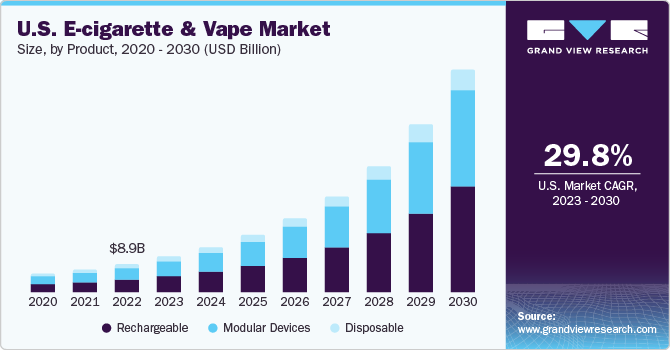
U.S. e-cigarette & vape market size, by product, 2016 - 2028 (USD Billion)

Due to the increasing health concern over the usage of conventional tobacco cigarettes, the market is expected to witness significant growth. The U.S. owns the widest e-cigarette and vape mod distribution network for sale. However, the new taxation rules among the states of the country are expected to act as potential threats to market growth during the forecast period.

U.S. E-cigarette & Vape Market Segmentation

Grand View Research has segmented the U.S. e-cigarette and vape market based on product, component, and distribution channel:

Based on the Product Insights, the market is segmented into Disposable, Rechargeable, and Modular Devices.

  • The rechargeable segment led the market and accounted for more than 45.0% share of the global revenue in 2020. The lower costs of rechargeable cigarettes are expected to drive the adoption of these devices among users. A rechargeable cigarette is a battery-powered vaping device, which can be reused and refilled.
  • The modular devices segment is anticipated to register the highest growth over the forecast period. These devices are widely adopted by users as these devices have larger batteries and hold more e-liquid. These devices’ features include voltage control, wattage control, and temperature control, among others.

Based on the Component Insights, the market is segmented into Atomizer, Vape Mod, Cartomizer, and E-liquid.

  • The vape mod segment dominated the market and accounted for more than a 51.0% share of the global revenue in 2020. Increasing demand for customized mods is expected to propel the segment growth over the forecast period. With these mods, customers can automatically control temperature levels.
  • The e-liquid segment is anticipated to register the highest growth over the forecast period. The e-liquids are easily available in numerous flavors such as menthol, chocolate, fruit and nuts, and tobacco, which is expected to encourage the usage of e-l iquids.

Based on the Distribution Channel Insights, the market is segmented into Online, and Retail Store.

  • The retail store segment led the market and accounted for more than 84.0% share of the global revenue in 2020. Retail stores allow customers to try out numerous e-liquid flavors and check the various kinds of vaporizers available in the market. Users choose to visit these retail stores to make these purchases.
  • The online segment is anticipated to register the fastest over the forecast period. Numerous vendors in the U.S. are opting for online channels as their preferred distribution channel over the retail stores due to stringent regulations about the sale and distribution of e-cigarettes.

Key Companies Profile & Market Share Insights

Prominent players in the market are adopting various strategies, such as product innovation, strategic joint ventures, partnerships, mergers and acquisitions, geographical expansion, research and development initiatives, to strengthen their foothold in the market. Moreover, players are focusing on offering their products through retail stores as well as online platforms. Players are also focusing on customizing their products, considering various factors into consideration, such as design and battery power. Also, e-liquid manufacturers are focusing on producing a variety of flavors of e-liquid and in different strengths.

Players are focusing on using lithium-ion rechargeable battery in electronic smoking devices. Moreover, vendors are focusing on launching a new product. For instance, in October 2018, Philip Morris International launched the next generation of IQOS-heated tobacco products. Through this initiative, the company aims at encouraging a large number of smokers to switch to e-cigarettes.

Some of the prominent players in the U.S. e-cigarette & vape market include:

  • Reynolds American Inc.
  • Imperial Brands
  • Altria Group, Inc.
  • Japan Tobacco Inc.
  • Philip Morris International
  • International Vapor Group
  • British American Tobacco
  • NicQuid
  • Shenzhen IVPS Technology Co., Ltd.
  • Shenzhen KangerTech Technology Co., Ltd.

Order a free sample PDF of the U.S. E-cigarette & Vape Market Intelligence Study, published by Grand View Research.
Europe Computer Numerical Control Machine Market Application Outlook and Research Report

Europe Computer Numerical Control Machine Industry Overview

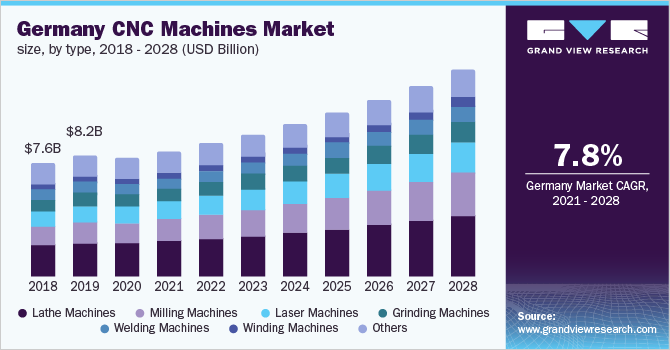
The Europe computer numerical control machine market size is expected to reach USD 37.27 billion by 2028, expanding at a CAGR of 7.4% from 2021 to 2028, according to a new study conducted by Grand View Research, Inc. The rising demand for multi-axis computer numerical control (CNC) machines equipped with automatic tool changers is expected to drive the growth of the market over the forecast period. CNC machines facilitate the production of components in lesser time and with greater accuracy. Advances in automation technology over the past few years have allowed manufacturers to introduce solutions that can potentially reduce a significant amount of repetitive work, and subsequently, the machining time. 

Germany CNC machines market size, by type, 2018 - 2028 (USD Billion)

Suppliers and buyers are struggling to maintain a seamless flow of goods and services as a result of the outbreak of the COVID-19 pandemic and the subsequent restrictions being imposed as part of the efforts to arrest the spread of coronavirus. Developing countries are particularly facing the direct consequences of supply chain disruptions and restricted trading activities. The outbreak of the pandemic has also resulted in the cancellation of several product launch events in 2020, thereby depriving manufacturers of the opportunity to showcase and market their new products and technologies. However, manufacturers have started convening online events to showcase their new products and technologies. For instance, in August 2020, Biesse Group had hosted the “Inside In Action”, a new hybrid, digital, and live online event to bring all divisions onto a common platform.

Europe Computer Numerical Control Machine Market Segmentation

Grand View Research has segmented the Europe computer numerical control machine market based on type, end-use, and country:

Based on the Type Insights, the market is segmented into Lathe Machines, Milling Machines, Laser Machines, Grinding Machines, Welding Machines, Winding Machines, and Others.

  • The lathe machines segment accounted for the largest revenue share of over 25% in 2020. Lathe machines have wide-ranging applications across various industries and industry verticals owing to their ability to machine all kinds of rotating surfaces.
  • The milling machines segment is anticipated to grow considerably over the forecast period. Milling machines aid in the process of metal removal while improving the accuracy of machining.
  • The ability of milling machines to perform operations on slots, gears, shafts, spiral surfaces, and several other curved surfaces is expected to drive the demand for milling machines over the forecast period. 

Based on the End-use Insights, the market is segmented into Automotive, Aerospace & Defense, Construction Equipment, Power & Energy, Industrial, and Others.

  • The industrial segment accounted for the largest market share of over 20% in 2020. CNC machines are particularly used by incumbents of the industries and industry verticals that involve manufacturing, metal cutting, metal removing, fabrication, and other machining operations to perform the machining of workpieces.
  • The automotive segment is anticipated to grow significantly over the forecast period. Europe is considered the automotive hub of the world.
  • The presence of major automotive manufacturers in European countries, such as Germany, France, Italy, and the U.K., is primarily driving the demand for CNC machines across Europe.
  • CNC machines can help in producing high-value parts with accuracy and machining intricate parts without employing any additional resources. Hence, the demand for computer numerical control machines from the incumbents of the power and energy industries is also increasing significantly.

Key Companies Profile & Market Share Insights

The market can be described as a highly fragmented market owing to the presence of several market players, including both established, and local and regional market players, catering to a limited number of clients. Hence, the market is witnessing intense competition among the market players. The intensifying competition is prompting several market players to focus on launching new products and upgrading their existing products. For instance, in November 2020, Hurco Companies Inc. introduced three models of CNC turning centers, include TM10Mi XP, TM8Mi XP, and M12Mi XP, as part of the efforts to expand its existing product range.

Research and development activities play a vital role in the development of CNC machines. As this is an established market with several active players spread all over the world, the market participants focus on adopting the latest technologies to offer innovative features, such as connectivity between computers and CNC machines and software solutions facilitating remote monitoring of the CNC machines through computers.

Some of the prominent players operating in the Europe computer numerical control machine market are:

  • Amada Machine Tools Co., Ltd.
  • Amera-Seiki
  • DMG Mori Co., Ltd.
  • Dalian Machine Tool Group Corporation
  • FANUC Corporation
  • Haas Automation, Inc.
  • Hurco Companies, Inc.
  • Okuma Corporation
  • Shenyang Machine Tool Co., Ltd.
  • Yamazaki Mazak Corporation

Order a free sample PDF of the Europe Computer Numerical Control Machine Market Intelligence Study, published by Grand View Research.

5G Chipset Market Overview by Product, Application, Regional Demand and Prominent Players

5G Chipset Industry Overview

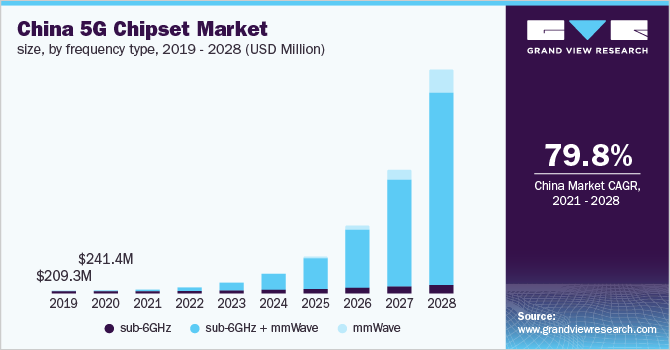
The global 5G chipset market size is expected to reach USD 66.45 billion by 2028, according to a new study by Grand View Research, Inc. It is expected to expand at a CAGR of 69.1% from 2021 to 2028. The rapidly rising demand for ultra-reliable and low-latency data networks capable of delivering seamless connectivity is estimated to boost market growth over the forecast period. As such, the 5G chipset is turning out to be an integral part of modern telecommunication equipment. 

China 5G chipset market size, by frequency type, 2019 - 2028 (USD Million)  

The growing popularity of 5G-enabled smartphones is emerging as a major factor that is estimated to propel market growth over the forecast period. Key smartphone manufacturers are responding to the growing demand for 5G smartphones by aggressively investing in vertical integration in order to diversify their businesses and augment revenues. 5G chipsets can be found in the latest smartphones, laptops, base stations, modems, and routers. These chipsets are also being installed in connected vehicles deployed as part of autonomous vehicle systems to provide improved Vehicle-to-Everything (V2X) connectivity. 

5G Chipset Market Segmentation

Grand View Research has segmented the global 5G chipset market on the basis of frequency type, processing node type, deployment type, vertical, and region:


Based on the Deployment Type Insights, the market is segmented into Telecom Base Station Equipment, Smartphones/Tablets, Connected Vehicles, Connected Devices, Broadband Access Gateway Devices, and Others.

  • The smartphones/tablets segment dominated the market with a share of nearly 55.0% in 2020. This is attributed to the growing demand for 5G-enabled smartphones for online gaming, watching Ultra High Definition (UHD) videos, and video calling applications.
  • The growing need to support multi-carrier frequencies is anticipated to drive the multi-mode segment over the forecast period. At the same time, the need to ensure ultra-reliable connectivity for the increasing number of connected devices being deployed continuously across the energy and utility, healthcare, and manufacturing industries is also growing.

Based on the Frequency Type Insights, the market is segmented into sub-6GHz, mmWave, and sub-6GHz + mmWave.

  • The sub-6GHz segment dominated the market with a share of more than 65.0% in 2020. This is attributed to the initial offerings of 5G chipset components supporting the sub-6GHz band by key market players for smartphones, connected cars, and laptops.
  • The sub-6GHz + mmWave segment is expected to register a noticeable CAGR over the forecast period owing to the continued introduction of the modern chipset components supporting both the sub-6GHz and mmWave bands in a single module.
  • The continued rollout of the Industrial Internet of Things(IIoT) and the growing popularity of autonomous cars have triggered the necessity for higher bandwidth and faster data networks. As a result, the chipset demand for supporting the mmWave band is expected to grow over the forecast period. 

Based on the Node Type Insights, the market is segmented into 7 nm, 10 nm, and others.

  • The 7 nm segment dominated the market with a share of 64.2% in 2020. This is attributed to the initial focus on developing 5G chipset components with a 7nm processing node by key players.
  • The 10 nm segment is expected to register a significant CAGR over the forecast period. Furthermore, as autonomous cars become more common, the need to maintain seamless connectivity between vehicles would also grow and higher processing nodes would have to be adopted to develop 5G chipset components.

Based on the Vertical Insights, the market is segmented into Manufacturing, Energy & Utilities, Media & Entertainment, IT & Telecom, Transportation & Logistics, Healthcare, and Others.

  • The IT and telecom segment dominated the market with a share of over 35.0% in 2020. This is attributed to the significant investments being made by the prominent players in developing 5G chipset modules for telecom base stations, broadband gateway devices, and other communication devices.
  • The need to establish seamless wireless communication between various robots, sensors, and actuators, which form an integral part of the manufacturing process, is also growing. As a consequence, the manufacturing segment is expected to exhibit the highest CAGR over the forecast period.

5G Chipset Regional Outlook

  • North America
  • Europe
  • Asia Pacific
  • Latin America
  • Middle East & Africa (MEA)

Key Companies Profile & Market Share Insights

Key players are adopting various strategies, including new product development and strategic collaborations, to strengthen their foothold in the market for 5G chipsets. At the same time, key smartphone manufacturers, such as Apple Inc., are focusing on vertical integration in order to enhance their product portfolios with 5G-enabled devices. The market incumbents are aggressively focusing on developing new and innovative products, expanding the overall product portfolios, and gaining a significant market share.

For instance, in February 2019, Qualcomm Incorporated introduced the Snapdragon X55 5G modem. The new modem supports sub-6GHz as well as mmWave bands. Major players are also investing in research and development to develop new multi-mode 5G chipset components. For instance, in 2018, Intel Corporation infused USD 28.7 billion in R&D to develop new and innovative technologies. The company also expected these investments to help in strengthening its competitive position in the market.

Some prominent players in the global 5G chipset market include:

  • Qualcomm Incorporated
  • Intel Corporation
  • Huawei Technologies Co., Ltd.
  • Samsung Electronics Co., Ltd.
  • MediaTek Inc.
  • Infineon Technologies AG
  • Unisoc Communications, Inc.
  • Xilinx Inc.
  • Qorvo, Inc.

Order a free sample PDF of the 5G Chipset Market Intelligence Study, published by Grand View Research.
Volumetric Display Market Summary, Key Buying Criteria, Revenue Growth Prospects and PESTEL Analysis

Volumetric Display Industry Overview

The global volumetric display market size is expected to reach USD 1.05 billion by 2028, according to a new study by Grand View Research, Inc. It is expected to expand at a CAGR of 25.8% from 2021 to 2028. Several in-built features such as visualization of holographic aerial images in free space, 360-degree spherical viewing angle, autostereoscopic capabilities, and motion-based depth cues are likely to drive the market over the forecast period. 

U.S. volumetric display market size, by display type, 2018 - 2028 (USD Million)

Volumetric displays are widely preferred across several industries such as military and defense, healthcare, media, communication, entertainment, and aerospace owing to their built-in features. Massive investments in R&D by prominent market players such as LightSpace Technologies Inc. are estimated to create a significant opportunity for players to gain a substantial market share over the coming years. Moreover, these investments are majorly focused on improving overall in-built features of volumetric displays, which will cater to growing consumer demand for enhanced visual experiences during gaming and other applications. Robust deployment of 5G network infrastructure is further anticipated to spur the adoption of volumetric displays to provide seamless connectivity and enhanced experience to customers during video calls.

Volumetric Display Market Segmentation

Grand View Research has segmented the global volumetric display market based on display type, end use, and region:

Based on the Display Type Insights, the market is segmented into Static-volume display, and Swept-volume display.

  • The static-volume segment held the largest market share of more than 50.0% in 2020 and is anticipated to expand at a significant CAGR over the forecast period. Static volumetric displays are highly preferred among customers due to their ease of availability in various categories.
  • The swept volume segment is expected to exhibit a CAGR of 27.1% from 2021 to 2028. The growth is attributed to the significant focus on developing advanced swept volume displays by prominent market players globally.

Based on the End-use Insights, the market is segmented into Medical, Aerospace & Defense, Automotive, Media, Communication, & Entertainment, Education & Training, and Others (Oil & Gas, Mining, etc.).

  • The medical segment captured over 37.6% share in the global market and is expected to expand at the highest CAGR among the end-use segments from 2021 to 2028.
  • The volumetric display has gained momentum in the field of medical imaging applications owing to its significant use during surgeries.
  • Moreover, volumetric displays deliver a remarkable visual impact during product advertisement and media marketing of a product by engaging customers for a long time.
  • With the emergence of 5G technology, the media, communication, and entertainment industry is also expected to witness remarkable growth in the coming years due to significant demand for the product for video calling and virtual meeting purposes.

Volumetric Display Regional Outlook

  • North America
  • Europe
  • Asia Pacific
  • Rest of the World

Key Companies Profile & Market Share Insights

Industry players have been focusing on organic growth strategies such as R&D investments, collaborations, and value-added features to expand their overall product portfolios and gain a larger share in the market. For instance, in November 2018, Voxon Photonics tested a successful video call on volumetric display by using a 5G network at the Mobile World Congress Americas in Los Angeles. This strategy is aimed at helping Voxon Photonics enhance its product sales across the globe after the commercialization of 5G services in 2020.

Moreover, the market is presently at its infancy, which allows existing players to fortify their market presence while presenting an opportunity for new entrants to foray into the industry. Additionally, key players are focusing on establishing partnerships and agreements with investors to raise funding to expand their market presence. For instance, in Dec 2018, LightSpace Technologies raised USD 5.5 million from ASHansaMatrix, backed by the European Investment Bank (EIB). The major purpose of the investment is to support R&D activities of real-time volumetric display technology, along with the development of industrialization and fabrication process of photonics elements.

Some of the prominent players operating in the global volumetric display market are:

  • Lightspace Technologies Inc.
  • Voxon Photonics Pty Ltd.
  • The Coretec Group Inc.
  • Holoxica Ltd.
  • Alioscopy
  • Leia, Inc
  • Looking Glass Factory, Inc.
  • SeeReal Technologies GmbH
  • The Coretec Group, Inc.

Order a free sample PDF of the Volumetric Display Market Intelligence Study, published by Grand View Research.
Automotive Emission Test Equipment Market Business Drivers, Top Companies and Competitive Analysis

Automotive Emission Test Equipment Industry Overview

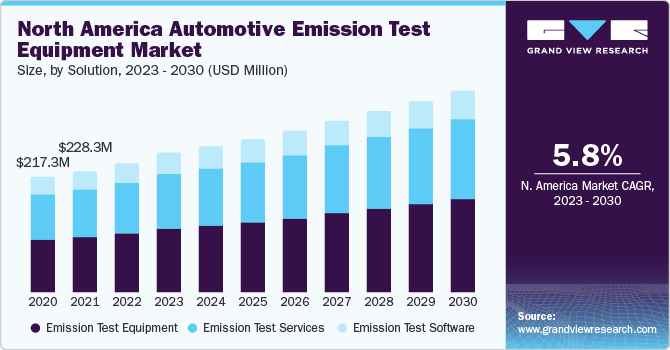
The global automotive emission test equipment market size is expected to reach USD 971.9 million by 2028, according to a new study by Grand View Research, Inc. It is expected to expand at a CAGR of 5.09% from 2021 to 2028. The demand for automotive emission test systems is estimated to increase owing to stringent regulations associated with vehicle exhaust emissions and soaring need for regular periodic technical inspections (PTI) that are aimed at regulating gaseous emissions from exhaust vehicles. Rising concerns to limit adverse environmental effects caused by passenger and light-duty vehicles are also expected to drive the automotive emission test equipment market over the forecast period. 

North America automotive emission test equipment market size, by solution, 2018 - 2028 (USD Million)

The emission test equipment segment held the largest share in the automotive emission test system market in 2018. It is likely to maintain its dominance in through 2025, on account of surging demand for testing equipment worldwide, especially from automobile manufacturers. Furthermore, the emission test services segment in the automotive emission test system market is a developed business sector across the U.S. and EU member nations. The growth of the segment can be attributed to increasing demand for service centers owing to emission targets mentioned by governments of EU countries.

Automotive Emission Test Equipment Market Segmentation

Grand View Research has segmented the global automotive emission test equipment market based on solution, emission equipment, and region:

Based on the Solution Insights, the market is segmented into Emission Test Equipment, Emission Test Software, and Emission Test Services.

  • The emission test equipment segment led the automotive emission test equipment market and accounted for more than 47% of the global revenue in 2020.
  • The emission test services segment is expected to register the highest CAGR of 5.9% from 2021 to 2028 owing to increasing emphasis placed on reducing releases of greenhouse gases by passenger and light-duty vehicles, especially in developing countries such as China and India.
  • These services help in ensuring that vehicle exhaust systems are operating within standard norms and limitations through periodic technical inspection. Rising adoption of service business, particularly across developing nations, is also contributing to the growth of the segment.

Based on the Emission Equipment Insights, the market is segmented into Opacity Meters/Smoke Meters, and Other Vehicle Emission Test Equipment/Components.

  • The other vehicle emission test equipment/components segment led the market and accounted for more than 84% of the global revenue in 2020. The segment anticipated to maintain its dominance through 2028.
  • The growth of the segment can be attributed to rising demand for automotive emission test systems by a large number of automobile manufacturers across the world. Advancements in vehicle emission diagnostic systems such as onboard diagnostic tools are also supplementing the growth of the other segment.
  • The smoke meters segment is projected to experience a CAGR of 3.26% during the forecast period. The demand for smoke meters is rising in vehicle emission test system market as they are used to detect and measure smoke emitted from diesel engines.

Automotive Emission Test Equipment Regional Outlook

  • North America
  • Europe
  • Asia Pacific
  • Rest of the World

Key Companies Profile & Market Share Insights

This system is intended to provide analysis and collection of exhaust data from various sources, which include non-road mobile machinery or vessels and light- and heavy-duty vehicles. Likewise, Snap-on Incorporated introduced a new emission analyzer. The DGA5000 product was designed for modern workshop and is available as a diesel analyzer or standalone gas analyzer and as a combined unit. The analyzer allows measuring oil temperature and vehicle RPM.

Some of the prominent players operating in the global automotive emission test equipment market are:

  • Opus Inspection
  • Gemco Equipment Ltd
  • TÜV Nord Group
  • CAPELEC
  • HORIBA, Ltd.
  • Applus+
  • SGS SA
  • AVL LIST GmbH
  • TEXA S.p.A.

Order a free sample PDF of the Automotive Emission Test Equipment Market Intelligence Study, published by Grand View Research.
Some Key Players Operating in The Smart Retail Market Include Huawei Technologies and Intel Corporation

Smart Retail Industry Overview

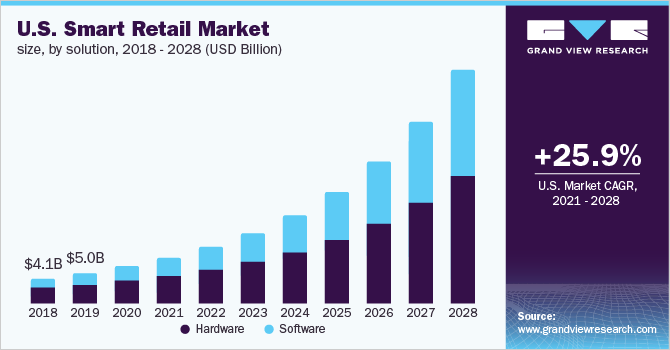
The global smart retail market size is expected to reach USD 134,347.9 million by 2028, registering a CAGR of 27.7% from 2021 to 2028, according to a study conducted by Grand View Research, Inc. The growth is attributed to the Increasing adoption of latest technologies, such as Virtual Reality (VR), Augmented Reality (AR), Artificial Intelligence (AI), and Internet of Thing (IoT), to enhance in-store shopping experience, increasing investments in retail industry, and growing preference for cashless transactions. Moreover, retailers are increasingly adopting analytical solutions to ensure a competitive edge over their competitors by improving business operations and better understanding their customers. The growing adoption of analytics, which can potentially augment profitability across physical and online stores, is anticipated to drive the growth of the smart retail market over the forecast period. The potential use of robots for providing in-store customer service is also expected to contribute to the growth of the market. 

U.S. smart retail market size, by solution, 2018 - 2028 (USD Billion)

The COVID-19 outbreak has significantly affected businesses such as conventional retail, travel, and manufacturing. However, it has opened new opportunities for healthcare, food delivery, e-commerce, smart retail, and online gaming. On the other hand, the supply chains are in jeopardy and product shortages are becoming evident due to the lockdowns imposed in various parts of the world. As consumers begin to lose trust, companies are finding new ways to cater to the changing customer expectations. Demand for smart retail is experiencing growth owing to lockdowns and social distancing rules by government bodies. Businesses that were earlier using offline retailing are now turning to digital operations. Though majority business sectors globally have experienced the negative effects of the pandemic; technologies such as smart retail can bring businesses back on track as it provides better safety and easy purchase for consumers. 

Smart Retail Market Segmentation

Grand View Research has segmented the global smart retail market based on solution, application, and region:

Based on the Solution Insights, the market is segmented into Hardware and Software.

  • The hardware segment dominated the market in 2020 and accounted for more than 65% of the global revenue.
  • The growing deployment of Augmented Reality (AR) and Virtual Reality (VR) devices, point of sale (POS) systems, Bluetooth beacons, and Radio-frequency identification (RFID) systems to offer a seamless in-store shopping experience to customers is augmenting the growth of the segment.
  • The software segment is projected to expand at the highest CAGR of 29.9% over the forecast period.
  • Increasing the adoption of analytics software by retailers across the world, to understand specific end-users needs and behavior to improve customer engagement and the shopping experience is one of the crucial factors stimulating the growth of the segment.

Based on the Application Insights, the market is segmented into Visual Marketing, Smart Label, Smart Payment System, Intelligent System, and Others (Robotics, analytics).

  • The visual marketing segment dominated the market in 2020 and accounted for more than 25% of the global revenue.
  • The growth of the e-commerce industry has also opened several opportunities for brick-and-mortar stores. Such stores are utilizing visual marketing for their products and offerings in the form of product snapshots and videos to engage customers and gain traction on e-commerce websites.
  • The smart payment system segment is projected to witness considerable growth over the forecast period. The growth can be attributed to the initiatives being pursued to promote digital payments and the growing need to enhance the customer experience.

Smart Retail Regional Outlook

  • North America
  • Europe
  • Asia Pacific
  • Latin America
  • Middle East & Africa (MEA)

Key Companies Profile & Market Share Insights

Presently, the market players are pursuing both organic and inorganic growth strategies to increase their market share. For instance, NCR Corporation announced Horizon, a data-driven self-checkout consultancy and web-based analytics system for the retail sector. This consultancy analyzes data generated at self-checkout to provide actionable insights to retailers to improve store operation and checkout experience for customers. Similarly, Walmart Investments Cooperative U.A. invested USD 37.7 million in Wal-Mart India Pvt. Ltd to expand its presence in the Indian market.

Some of the prominent players operating in the global smart retail market are:

  • com, Inc.
  • NCR Corporation
  • PAX Global Technology Limited
  • Ingenico, Fiserv, Inc.
  • Google LLC
  • Honeywell International Inc.
  • Huawei Technologies Co., Ltd.
  • LG Display Co., Ltd.
  • Intel Corporation
  • Samsung Electronics
  • Verifone Systems
  • IBM Corporation

Order a free sample PDF of the Smart Retail Market Intelligence Study, published by Grand View Research.

Rear-view Mirror Market Size, Share and Trends Analysis Report by Mounting Location, 2028

Rear-view Mirror Industry Overview

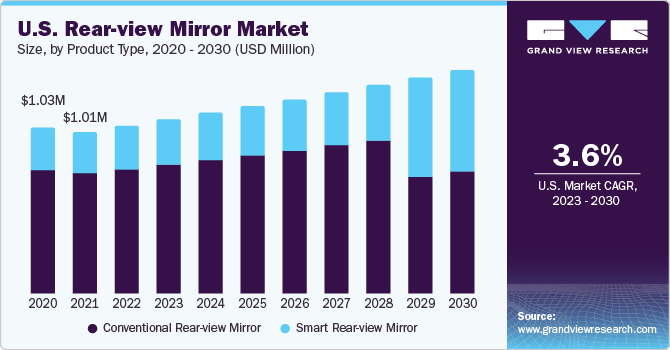
The global rear-view mirror market size is expected to reach USD 11.51 billion by 2028, expanding at a CAGR of 4.1% from 2021 to 2028, according to a new report by Grand View Research, Inc. The COVID-19 pandemic has negatively impacted the demand for rear-view mirrors in 2020. The implementation of lockdowns and social distancing norms globally led to losses in the automotive industry. However, as governments begin to gradually relax lockdown norms and allow businesses to operate with mandates of social distancing, the market can expect a period of respite for the short term. Moreover, the increasing demand for luxury vehicles, coupled with the growing demand for enhanced comfort, is anticipated to drive market growth. Automotive OEMs are focused on integrating advanced safety features in rear-view mirrors to improve visibility and reduce accidents. The rapid rate of advancements in product features is anticipated to work in favor of market growth. 

U.S. rear-view mirror market size, by product type, 2016 - 2028 (USD Billion)

The rising demand for luxury vehicles, thanks to the increased spending capacity of consumers, especially in developing economies such as China and India, is also driving the market. According to the China Automobile Dealers Association, luxury car dealers sold 277,000 units in April 2020, an increase of 11.1% compared to the same time in 2019. Furthermore, the introduction of an increasing number of luxury Sport Utility Vehicles (SUVs) is also expected to help the market expand at a promising pace over the forecast period.

Rear-view Mirror Market Segmentation

Grand View Research has segmented the global rear-view mirror market based on feature type, mounting type, product type, type, vehicle type, and region:

Based on the Feature Type Insights, the market is segmented into Auto-dimming, Blind Spot Detection, Power Control, Automatic Folding, Heating Function, and Others.

  • The heating function segment accounted for the largest revenue share of over 49% in 2020 and is anticipated to maintain its dominance over the forecast period, particularly in North America and Europe, due to its extensive usage in cold weather.
  • The blind-spot detection segment is projected to register the highest CAGR of over 5% in terms of revenue over the forecast period. This growth can be attributed to the continuous strengthening of vehicle safety standards and growing awareness among people about vehicle safety.

Based on the Product Type Insights, the market is segmented into Smart Rear-view Mirror, and Conventional Rear-view Mirror.

  • The smart rear-view mirror segment accounted for the largest share of around 70% of the market in 2020. These products have an in-built camera and enable the driver to switch between a traditional rear-view mirror to an LCD monitor screen. These mirrors help provide enhanced visibility in bad weather conditions or if the view is blocked due to tall cargo and commercial vehicles. 
  • The conventional rear-view mirror segment is estimated to register a CAGR exceeding 2% from 2021 to 2028. The demand is increasing in commercial vehicles owing to their benefits, such as reduced blind spots and increased visibility. Conventional mirrors offer an enhanced left and right-side view to heavy commercial vehicles. 

Based on the Mounting Location Insights, the market is segmented into Door Mounted, and Body Mounted.

  • The door-mounted segment accounted for the largest revenue share of around 70% in 2020. Door-mounted mirrors are also known as side or wing mirrors and are largely used in luxury cars. The positioning allows the driver to adjust the mirror as per visibility.
  • The body-mounted segment is projected to register a CAGR exceeding 3% from 2021 to 2028. Body-mounted mirrors are used in commercial vehicles where drivers need to keep a constant track of trailing vehicles. 

Based on the Type Insights, the market is segmented into Exterior Mirror, and Interior Mirror.

  • The exterior mirror segment accounted for the largest share of around 70% of the market in 2020. Exterior mirrors work as a replacement for side-view mirrors and offer help in lane changing and parking. Moreover, they also help avoid traffic accidents, driving fatigue, and traffic violations. 
  • The interior mirror segment is estimated to register a CAGR exceeding 3% from 2021 to 2028. Auto-dimming interior rear-view mirrors are finding increased demand in a range of vehicles as they improve driving safety by eliminating glare.  

Based on the Vehicle Type Insights, the market is segmented into Passenger Car, and Commercial Vehicles.

  • The passenger car segment accounted for the largest share of over 60% of the market in 2020. Passenger vehicles include all personal use transport vehicles, such as SUVs, luxury vehicles, and sedans, and are commonly designed to accommodate up to five individuals. The segment is estimated to expand at the highest CAGR during the forecast period, owing to the increasing vehicle fleet and vehicle per capita globally.
  • The commercial vehicle segment is projected to register a CAGR of over 4.0% over the forecast period. Commercial vehicles include Light Commercial Vehicles (LCVs) and Heavy Commercial Vehicles (HCVs). The adoption of commercial vehicles is expected to increase over the next eight years owing to sustained economic activities, increased spending on the infrastructure sector, increasing e-commerce and mining activities, and lower interest rates on commercial vehicles.

Rear-view Mirror Regional Outlook

  • North America
  • Europe
  • Asia Pacific
  • Latin America
  • Middle East & Africa (MEA)

Key Companies Profile & Market Share Insights

The key players in 2020 include Gentex Corporation, Continental AG, Valeo, Magna International, Inc., and Murakami Corporation. Most of these companies are focusing on offering technologically-driven and advanced products to strengthen their hold on the market. Companies are also undertaking strategic initiatives such as regional expansions, acquisitions, mergers, and collaborations to grow in the market. Organic growth remains the key strategy for the overall industry focusing on product launch to develop new and innovative products and expand product offerings. For instance, in November 2020, Magna International, Inc. announced the launch of its next-generation camera-based driver assistance system, the Magna Gen5 “one-box”. It is a Mobileye EyeQ5-based system that features the forward-facing camera system as well as the related software in a single unit.

Some of the prominent players operating in the global rear-view mirror market are:

  • Continental AG
  • Ficosa Internacional SA
  • Gentex Corporation
  • Ishizaki Honten Company Limited
  • Magna International Inc.
  • MITSUBA Corporation
  • Murakami Corporation
  • SL Corporation
  • Tokairica Co, Ltd.
  • Valeo

Order a free sample PDF of the Rear-view Mirror Market Intelligence Study, published by Grand View Research.
Which service segment accounted for the highest IoT in retail market share?

Internet Of Things In Retail Industry Overview

The global internet of things in retail market size is expected to reach USD 182.04 billion by 2028, registering a CAGR of 26.0% over the forecast period, according to a new report by Grand View Research, Inc. The growth can be attributed to the adoption of connected technologies by retailers against e-commerce sites. The reducing cost of hardware and IoT sensors, demand for a seamless shopping experience, and growing acceptance of smart payment are the factors expected to further fuel the growth of the internet of things (IoT) in retail market. 

U.S. internet of things in retail market size, by solution, 2017 - 2028 (USD Billion)

The tectonic shift in optimizing retail operations is triggering IoT adoption. Retailers are experimenting with IoT, which allows them to determine the purchase history and customer’s profile by synchronizing with wearable devices. The adoption of common standards and the proliferation of connected devices are augmenting the growth of IoT-enabled capabilities across the retail industry. Moreover, the technology provides endless capabilities and improvements in the retail sector and enables retailers to explore customer behavior, optimize productivity, and create new business models.

Internet Of Things In Retail Market Segmentation

Grand View Research has segmented the global internet of things in retail market based on solution, service, technology, and region:

Based on the Service Insights, the market is segmented into Professional Services, and Managed Services.

  • The professional services segment accounted for the highest market share of over 55% in 2020. Professional services include consulting, application management, and infrastructure management services. The high adoption of IoT in the retail sector has increased the demand for infrastructure and application management services.
  • The payment-as-a-service solution offers retailers with terminal management services and gateway solutions that enable efficient routing of transactions, multichannel acceptance and processing, and payment value-added services such as mobile banking, POS terminals, and payment gateway.

Based on the Solution Insights, the market is segmented into Hardware, and Software.

  • The hardware segment accounted for the highest revenue share of over 60% in 2020. The surge in the number of interconnected devices in retail outlets and the decreasing prices of IoT sensors are expected to propel the segment growth.
  • The increasing adoption of retail analytics is expected to augment the software segment growth over the next seven years. The proliferation of smartphones and the use of mobile applications are driving the retail software segment growth.

Based on the Technology Insights, the market is segmented into Bluetooth Low Energy, Near Field Communication, ZigBee, and Others.

  • The near field communication(NFC) segment accounted for a prominent market share of 30% in 2020. An NFC combines contactless smart card technology with mobile devices and allows streamlined payment transactions compared to traditional cash and card payment methods. 
  • The emergence of mobile wallets has transformed the payment methods in the retail sector, providing a boost to NFC adoption
  • Initially, Bluetooth Low Energy (BLE) gained notable traction as it allowed the designing of single-mode chips, which can be used in low-cost battery-powered devices. The technology can affect several aspects of the retail customer experience.
  • Furthermore, with regards to payments, the technology makes store check-in and intelligent interaction much easier to implement.

Internet Of Things (IoT) In Retail Regional Outlook

  • North America
  • Europe
  • Asia Pacific
  • Latin America
  • Middle East & Africa (MEA)

Key Companies Profile & Market Share Insights

The market is fragmented with the presence and operation of many regional and international players. IBM Corporation; Impinj Inc.; Google LLC; Microsoft Corporation; and PTC Inc. are some of the leading players in the global IoT in the retail space. These companies are actively working on developing new solutions for the retail industry. Recently, in October 2020, Losant IoT partnered with Vanteon Wireless Solutions to develop an edge-to-cloud solution for multiple connected devices. In 2018, IBM Corporation announced the expansion of its Watson IoT business in Europe, providing IoT solutions for European clients such as Cooperativa Sole, an Italy-based agriculture product company.

Some of the prominent players operating in the internet of things in retail market are:

  • Arm Limited
  • Cisco Systems Inc.
  • Google LLC
  • IBM Corporation
  • Impinj, Inc.
  • Intel Corporation
  • Losant IoT
  • Microsoft Corporation
  • NXP Semiconductors

Order a free sample PDF of the Internet Of Things (IoT) In Retail Market Intelligence Study, published by Grand View Research.
Key Players Operating in the Medical Disposables Market include Abbott and Dickinson & Company

Medical Disposables Industry Overview

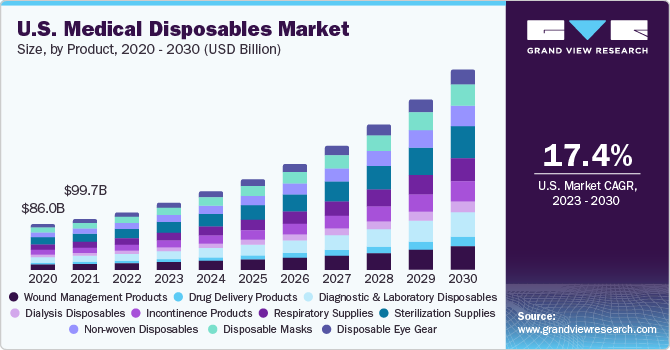
The global medical disposables market size is expected to reach USD 1086.6 billion by 2028, according to a new report by Grand View Research, Inc., expanding at a CAGR of 16.7% from 2021 to 2028. Rising incidence of Hospital Acquired Infections (HAIs), impact of COVID-19 outbreak, and increasing number of surgical procedures are the key factors driving the market for medical disposables. 

U.S. medical disposables market size, by product, 2018 - 2028 (USD Billion)

Increasing number of surgeries globally is a key factor expected to drive the market over the forecast period. For instance, as per Mölnlycke Health Care AB, 70.00 million surgical procedures are performed every year in Europe. As such, medical disposable products such as hospital gowns, disposables eye gear, hand sanitizers, respiratory supplies, and sterilization supplies, which are being an essential requirement for surgical procedures, are expected to witness high demand over the forecast period. For instance, as per the report published by the Organization for Economic Co-operation and Development (OECD), around 390,352 surgeries were performed in Canada in 2017. Disposable products prevent the transmission of nosocomial infections to some extent owing to which surgeons consistently prefer to use disposable products over the reusable ones. Such factors are expected to boost market growth. 

Medical Disposables Market Segmentation

Grand View Research has segmented the global medical disposables market on the basis of product, raw material, end use, and region:

Based on the Product Insights, the market is segmented into Wound Management Products, Drug Delivery Products, Diagnostic and Laboratory Disposables, Dialysis Disposables, Incontinence Products, Respiratory Supplies, Sterilization Supplies, Non-woven Disposables, Disposable Masks, Disposable Eye Gear, Disposable Gloves, Hand Sanitizers, and Others.

  • The sterilization supplies segment dominated the market for medical disposables and held the largest revenue share of over 13.0% in 2020.
  • The increasing demand for sterilization supplies due to the outbreak of the pandemic in hospitals and clinics is a major factor influencing the segment growth.
  • In addition, the absence of effective alternatives and the development of products with innovative packaging is also expected to have a positive impact on the growth of this segment.
  • The outbreak of COVID-19 has tremendously surged the demand for hand sanitizers across the globe.

Based on the Raw Material Insights, the market is segmented into Plastic Resin, Nonwoven Material, Rubber, Paper and Paperboard, Metals, Glass, and Others.

  • Based on raw material, the plastic resins segment dominated the market and accounted for the largest revenue share of over 58.0% in 2020.
  • The growing prevalence of hospital-acquired infections and the subsequent rising usage of disposable items to prevent the spread of COVID-19 is boosting the market growth.
  • The non-woven material segment is anticipated to witness the fastest growth over the forecast period.

Based on the End-use Insights, the market is segmented into Hospitals, Home Healthcare, Outpatient/Primary Care Facilities, and Others.

  • The hospital segment dominated the market and held the largest revenue share of 54.0% in 2020. This is due to the rising number of patient admissions in hospitals for surgeries and treatments for COVID-19.
  • The home healthcare segment is anticipated to witness considerable growth over the forecast period.
  • Medical disposables in the home healthcare segment mainly include used needles, syringes, lancets, solid bandages, disposable sheets, and gloves.
  • The demand for home healthcare is rapidly increasing owing to the rising geriatric population coupled with the government legislation to reduce hospital readmissions.

Medical Disposables Regional Outlook

  • North America
  • Europe
  • Asia Pacific
  • Latin America
  • Middle East & Africa (MEA)

Key Companies Profile & Market Share Insights

Key players are involved in adopting strategies such as mergers and acquisitions, product launches, partnerships, and agreements to strengthen their position in the market.

Some of the prominent players in the medical disposables market include:

  • Medline Industries, Inc.
  • Smith & Nephew PLC
  • Bayer AG
  • BD
  • 3M
  • Cardinal Health

Order a free sample PDF of the Medical Disposables Market Intelligence Study, published by Grand View Research.
Which Application Segment Is Expected To Show The Fastest Growth In The Brain Implants Market?

Brain Implants Industry Overview

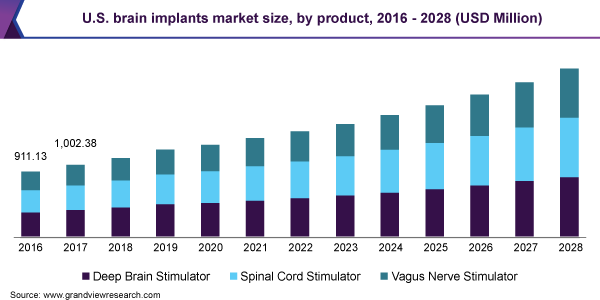
The global brain implants market size is anticipated to reach USD 9.2 billion by 2028, according to a new report by Grand View Research, Inc. The market is expected to expand at a CAGR of 9.1% from 2021 to 2028. The rise in neurological disorders such as epilepsy, Parkinson’s disease, depression, and tremors as well as growing investments in R&D to develop cost-effective brain implants is attributing to the growth of the market. 

U.S. brain implants market size, by product, 2016 - 2028 (USD Million)

The presence of a large population base suffering from various neurological and physiological disorders and conditions is expected to boost the demand for implants during the forecast period. For instance, as per the Parkinson’s Foundation 2016 report, over 10 million people globally are living with Parkinson’s disease (PD). Thus, the increasing cases of PD are expected to drive the market. However, the outbreak of the COVID-19 pandemic is restricting the growth of the market. For instance, as per the Neuromodulation Society of the U.K. and Ireland, in the U.K. all the NHS hospitals were instructed to suspend all the non-urgent elective surgeries due to the pandemic from 15th April in 2020 for at least three months. 

Brain Implants Market Segmentation

Grand View Research has segmented the global brain implants market on the basis of product, application, and region:

Based on the Product Insights, the market is segmented into Deep Brain Stimulator, Spinal Cord Stimulator, and Vagus Nerve Stimulator.

  • The deep brain stimulators segment dominated the market for brain implants and accounted for the largest revenue share of 37.0% in 2020, owing to its use in various applications in neurological disorders.
  • The growing adoption of DBS for the treatment of various neurological disorders including obsessive-compulsive disorder, Parkinson’s diseases, dystonia, essential tremor, epilepsy, and Alzheimer’s disease is a key growth driver of this segment.
  • The vagus nerve stimulator segment is expected to grow at the highest compound annual growth rate (CAGR) of 9.5% from 2021 to 2028, owing to applications in the treatment of various disorders such as anxiety, migraines, fibromyalgia, tinnitus, and obesity. It is mainly used to deliver electrical impulses to the vagus nerve.
  • In addition, product launches with advanced technology are enhancing the quality of therapy. For instance, in 2017 Neuro Science company launched the first non-invasive vagus nerve stimulation therapy product called GammaCore. This is also likely to bolster market growth. 

Based on the Application Insights, the market is segmented into Chronic Pain, Epilepsy, Parkinson’s disease, Depression, Essential Tremor, and Alzheimer’s disease.

  • The chronic pain segment dominated the market for brain implants and accounted for the largest revenue share of 58.8% in 2020. An increase in the incidence of chronic pain has created clinical urgency for incorporating long-term solutions.
  • The Parkinson’s disease segment is expected to witness the highest CAGR of 10.1% from 2021 to 2028 owing to the increasing number of the geriatric population who are prone to conditions such as Parkinson’s and Alzheimer’s diseases. 

Brain Implants Regional Outlook

  • North America
  • Europe
  • Asia Pacific
  • Latin America
  • Middle East & Africa (MEA)

Key Companies Profile & Market Share Insights

Developing cost-efficient and technologically advanced brain implants is the key focus of the companies operating in this market. Market leaders are involved in extensive research for the development of advanced brain implant technologies. Subsequently, the introduction of new products is expected to provide this market with lucrative growth opportunities. For instance, Abbott secured the U.S. FDA approval in September 2019 for its Proclaim XR recharge-free SCS system for chronic pain management. This system operates by utilizing low doses of electrical pulses that help extend the system's battery life for up to ten years.

Moreover, emerging players such as NeuroPace, Inc. and Synapse Biomedical Inc., are considered innovators for the market. Products offered by these competitors have a good price-performance proposition, competitive functionality, and are technologically advanced. These emerging companies are continuously investing in research and development activities as well as product commercialization events. For instance, in October 2017, NeuroPace, Inc. closed a USD 74 million funding round initiated by OrbiMed Advisors and KCK Groups. The funding will support the company’s ongoing efforts for rapid expansion and commercialization of its FDA-approved DBS product, the NeuroPace RNS system.

Some of the prominent players in the brain implants market include:

  • Medtronic
  • Boston Scientific Corporation
  • Jude Medical (Abbott)
  • NeuroPace, Inc.
  • Nevro Corporation
  • Synapse Biomedical Inc.
  • Aleva Neurotherapeutics SA 

Order a free sample PDF of the Brain Implants Market Intelligence Study, published by Grand View Research.
Brachytherapy Market Business Drivers, Top Companies and Competitive Analysis

Brachytherapy Industry Overview

The global brachytherapy market size is expected to reach USD 1.4 billion by 2028, according to a new study by Grand View Research Inc. The market is expected to expand at a CAGR of 7.1% from 2021 to 2028. The growth of the market is largely attributable to the rising prevalence of cancer, technology advancements, and increasing investment in R&D by major players. 

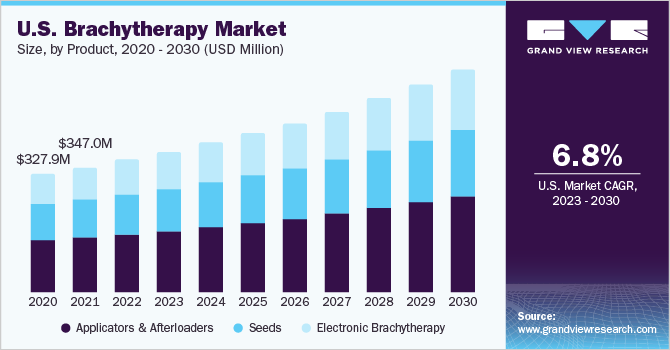
U.S. brachytherapy market size, by dosage type, 2017 - 2028 (USD Million)

According to the International Agency for Research on Cancer, the global incidence of cancer is expected to rise to 24.6 million by 2030, from 19.3 million in 2020. This is expected to be a major factor driving the growth of the market. Additionally, technological advancements and favorable reimbursement scenarios, particularly in the developed countries, are expected to drive market growth.

However, the lack of access to technologically advanced systems particularly in developing nations, and the lack of skilled radiotherapy professionals are expected to restraint market growth. Around 70% of the cancer-related deaths occur in low-and-middle-income countries; however, only 3-4% of the radiotherapy needs of the population in these countries are met. This represents significant opportunities for investment for the key market players. 

Brachytherapy Market Segmentation

Grand View Research has segmented the global brachytherapy market by product, dosage type, application, and region:

Based on the Product Insights, the market is segmented into Seeds, Applicators & Afterloaders, and Electronic Brachytherapy.

  • The seeds segment dominated the market and accounted for the largest revenue share of 30.5% in 2020.
  • Seeds are small radioactive materials that are placed inside the body. These seeds can be placed in the body permanently or temporarily depending on the type of cancer.
  • The electronic brachytherapy segment is expected to grow at the fastest rate during the forecast period.
  • The various advantages of electronic brachytherapy such as low dose radiation to the organ at risk, minimal exposure of treating staff to radiation, and no radioactive waste are some of the major factors driving the adoption of this technique.

Based on the Type Insights, the market is segmented into HDR, and LDR.

  • The HDR brachytherapy segment dominated the market and accounted for the largest revenue share of 71.2% in 2020.
  • LDR brachytherapy is primarily used for the treatment of prostate cancer. The introduction of new products such as GammaTile for the treatment of brain cancer is expected to drive the growth of this segment.

Based on the Application Insights, the market is segmented into Prostate Cancer, Gynecological Cancer, Breast Cancer, and Others.

  • The prostate cancer segment dominated the market and accounted for the largest revenue share of 32.9% in 2020.
  • The breast cancer brachytherapy application segment is expected to witness a CAGR of 7.6% during the forecast period. The increasing usage of brachytherapy in Accelerated Partial Breast Irradiation (APBI) is one of the major factors driving the growth of this segment.
  • Additionally, the rising incidence of breast cancer is also expected to drive the growth of this segment.

Brachytherapy Regional Outlook

  • North America
  • Europe
  • Asia Pacific
  • Latin America
  • Middle East & Africa (MEA) 

Key Companies Profile & Market Share Insights

Some of the key players have been present in the market for more than 35 years. They already have a well-established network of suppliers and customers, which helps in strengthening their market position. Additionally, some of the major companies also operate in other business domains. Hence, most often they are able to invest huge amounts for R&D activities.

New product launches and mergers and acquisitions are some of the major strategies adopted by the players in order to gain market share. For instance, in 2017, Eckert and Ziegler BEBIG GmbH acquired WOLF-Medizintechnik GmbH, which manufactures X-ray devices for skin tumor treatment. With rapid digitization in the field of medicine, more companies are focusing on integrated applications of hardware and software to develop next-generation oncology treatment solutions.

Some of the prominent players in the brachytherapy market include:

  • Varian Medical Systems, Inc.
  • Becton
  • Dickinson & Company
  • Elekta AB
  • Isoray Medical, Inc.
  • Eckert & Ziegler BEBIG
  • iCAD, Inc.
  • CIVCO Medical Solutions
  • Theragenics Corporation

Order a free sample PDF of the Brachytherapy Market Intelligence Study, published by Grand View Research.
Capsule Endoscopy Market Application Outlook and Research Report

Capsule Endoscopy Industry Overview

The global capsule endoscopy market size is expected to reach USD 939.5 million by 2028, according to a new report by Grand View Research, Inc. The market is expected to expand at a compounded annual growth rate (CAGR) of 8.7% from 2021 to 2028. The rising prevalence of colorectal cancer, gastrointestinal diseases, and other intestinal disorders is one of the major factors supporting market growth. In addition, the growing demand for accurate, faster, and precise diagnostic tools coupled with favorable government initiatives are some of the other factors boosting the market growth. 

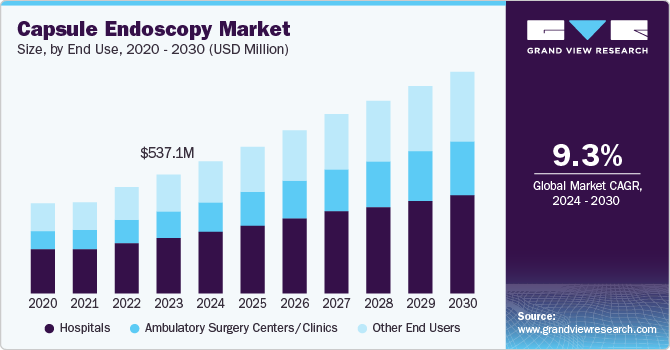
U.S. capsule endoscopy market size, by product type, 2018 - 2028 (USD Million)

The increasing prevalence of cancer, growing global geriatric population base, rising demand for minimally invasive diagnostic procedures, and introduction of technologically advanced capsules are the major factors bolstering the market growth. In addition, rising healthcare expenditure levels triggering the need for effective diagnostic procedures for cancer and supportive government initiatives are a few factors expected to boost the market growth. 

Capsule Endoscopy Market Segmentation

Grand View Research has segmented the global capsule endoscopy market based on product, application, end-use, and region:

Based on the Product Insights, the market is segmented into Capsule Endoscopes, and Systems.

  • The capsule endoscopes segment dominated the market for capsule endoscopy and accounted for the largest revenue share of 75.7% in 2020. In addition, this segment is anticipated to grow at the fastest rate during the forecast period.
  • The capsule endoscopes segment is segmented into types of capsules, such as small bowel, esophageal, and colon endoscopes.
  • Small bowel capsules contribute to the highest revenue share of the market in 2020 due to their rising utilization in the diagnosis and screening of medical conditions such as inflammatory bowel disease, Crohn’s disease, obscure GI tract bleeding (OGIB), and small bowel neoplastic lesions.
  • In addition, a growing preference toward less-invasive screening techniques is anticipated to support the growth of the market for capsule endoscopy during the forecast period.

Based on the End-use Insights, the market is segmented into Hospitals, Ambulatory surgery centers, Other end-uses.

  • The hospitals segment dominated the market for capsule endoscopy and accounted for the highest revenue share of 47.8%. It is attributed to the substantially large adoption, utilization of capsule endoscopy services, and such endoscopes in the hospitals compared to the other healthcare systems.
  • In addition, favorable reimbursement policies provided by the government are further boosting the market growth.
  • The ambulatory surgery centers/clinics segment is expected to grow at the fastest rate over the forecast period. Minimal time required for capsule endoscopy screening procedures and faster results are the key factors that are supporting the demand for these procedures in the ambulatory surgical centers/clinics systems. It is further affirmatively impacting the market growth.

Based on the Application Insights, the market is segmented into OGIB (obscure GI tract bleeding), Crohn’s Disease, Small Intestine Tumor, and Others.

  • The OGIB segment held the highest revenue share of 58.1% in 2020, due to numerous advantages provided by capsule endoscopy in the diagnosis and detection of OGIB.
  • In addition, benefits such as real-time visualization, image capturing, and analysis of the entire small intestine and reliable and precise results help increase the adoption of capsule endoscopes for OGIB.
  • The Crohn’s disease segment is anticipated to grow at a substantial rate during the forecast period due to the increasing utilization of capsule endoscopes for the detection of Crohn’s disease. It is one of the most common types of Inflammatory Bowel Diseases (IBD) and the rising prevalence of IBD, along with Crohn’s disease is anticipated to support market growth during the forecast period.

Capsule Endoscopy Regional Outlook

  • North America
  • Europe
  • Asia Pacific
  • Latin America
  • Middle East & Africa (MEA)

Key Companies Profile & Market Share Insights

There is significant competition amongst the existing players due to the growing demand for capsule-based endoscopes and endoscopy systems for various screening and diagnostic procedures. In addition, technological advancements in the field of endoscopy by key players is further increasing the competition. Some of the key players operating in the market are Given Imaging (Medtronic), IntroMedic Co., Ltd., Olympus Corporation, Chongqing Jinshan Science & Technology (Group) Co., Ltd, RF System lab, and CapsoVision.

Furthermore, strategic alliances with other market players, such as mergers and acquisitions, product launches, partnerships, and growing R&D in the area of capsule-based endoscopic technologies are some of the initiatives being undertaken by key market players to increase their market shares. In 2020, Medtronic announced its partnership with Amazon for home delivery of its capsule endoscope-PillCam Genius. It will help in increasing its penetration at a global level and enhancing patient comfort and satisfaction.

Some of the prominent players of the capsule endoscopy market include:

  • Given Imaging (Medtronic Plc)
  • Olympus Corporation
  • IntroMedic, Co. Ltd.
  • Chongqing Jinshan Science & Technology (Group) Co., Ltd.
  • CapsoVision
  • RF System lab

Order a free sample PDF of the Capsule Endoscopy Market Intelligence Study, published by Grand View Research.
Circulating Tumor Cells Market is driven by Expanding Applications of CTCs

Circulating Tumor Cells Industry Overview

The global circulating tumor cells market size is expected to reach USD 18.3 billion by 2027, according to a new report by Grand View Research, Inc. The market is expected to expand at a CAGR of 11.7% from 2021 to 2027. Many potential applications of CTCs in pre-diagnosis, pretreatment, and intra- and post-treatment provide lucrative growth opportunities to players involved in the development of CTC enrichment and isolation products Research organizations are engaged in endeavors aimed at developing CTC-based tests to improve cancer diagnosis in terms of efficiency and speed. 

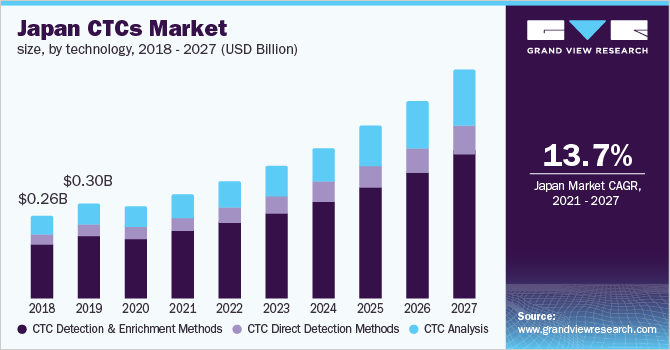
Japan CTCs market size, by technology, 2018 - 2027 (USD Billion)

Furthermore, the growing demand for minimally invasive diagnostic procedures is anticipated to propel investments by key stakeholders in this area. CTC-based liquid biopsy tests lead to limited trauma and enable rapid recovery owing to their non-invasive nature. Moreover, it enables minimal invasive screening of tumors before opting for complex surgical procedures, such as radiotherapy, chemotherapy, and surgical removal of tumors, thus positively impacting the adoption.

Circulating Tumor Cells Market Segmentation

Grand View Research has segmented the global Circulating Tumor Cells market on the basis of technology, application, product, specimen, and region:

Based on the Technology Insights, the market is segmented into CTC Detection & Enrichment Methods, CTC Direct Detection Methods, and CTC Analysis.

  • In 2020, the CTC detection and enrichment methods segment accounted for the largest revenue share of 65.8%.
  • The availability of different methods for the enrichment of circulating tumor cells in cancer detection is expected to significantly impact segment growth over the forecast period.
  • Moreover, positive or negative enrichment of circulating tumor cells based on biological properties is expected to hold significant potential for market growth.
  • Advancements in technologies such as immunofluorescence, NGS, FISH, and qPCR are anticipated to drive the clinical utility of these cells, and thus accelerating revenue growth for CTC analyses.
  • Several companies are investing in the development of products that help in CTC analysis and downstream assays. For instance, Vortex Biosciences offers various CTC analysis products, including immunofluorescence, cytopathology, cytogenetics (FISH), cell culture, and genomics.

Based on the Product Insights, the market is segmented into Kits & Reagents, Blood Collection Tubes, and Devices or Systems.

  • The devices or systems segment dominated the market and accounted for the largest revenue share of 42.8% in 2020. This can be attributed to the presence of a wide portfolio under this category coupled with upcoming advances with regard to microfluidics technology.
  • On the other hand, kits and reagents have also contributed significantly to the revenue due to the frequent purchase rate and high usage rate.

Based on the Specimen Insights, the market is segmented into Blood, Bone Marrow, and Other Body Fluids.

  • The blood specimen segment dominated the market and accounted for the largest revenue share of 46.9% in 2020.
  • A large concentration of these cells in blood samples as compared with other biospecimens is responsible for the largest penetration of this specimen type.
  • Membrane clogging as a result of a high concentration of blood cells minimizes the applicability of whole blood samples in microfluidic-based circulating tumor cells enumeration. Devices with various pore shapes and sizes are anticipated to overcome this issue and drive segment growth in the coming years.
  • The emergence of high throughput techniques has effectively accelerated the detection of genome variation among these cells, thereby driving the segment growth at a significant pace throughout the forecast period.

Based on the Application Insights, the market is segmented into Clinical/ Liquid Biopsy, and Research.

  • The research segment dominated the market and captured the largest revenue share of 72.8% in 2020.
  • Circulating tumor cells are regarded as a substrate of cancer metastasis. Circulating tumor cells enumeration remains largely a research tool.
  • Recently, the focus has shifted toward circulating tumor cells characterization and isolation, which can provide significant opportunities in predictive testing research.

CTCs Regional Outlook

  • North America
  • Europe
  • Asia Pacific
  • Latin America
  • Middle East & Africa (MEA)

Key Companies Profile & Market Share Insights

The market is consolidated with several emerging as well as established players. The market is witnessing high competition among both public and private firms. The players are adopting several measures to sustain market competition with the changing trends which exerts a positive impact on the overall market. The companies are collaborating with other market players to gain a competitive advantage in the space.

For instance, in November 2019, Biolidics Limited signed an agreement with Sysmex Corporation to develop a laboratory-developed test for the diagnosis of cancer. Since 2016, the companies collaborated for R&D of laboratory assays in this field by using ClearCell FX1 System along with Sysmex’s MI-FCM, a molecular imaging flow cytometer. This extension in collaboration helped the company expand its product portfolio.

Some of the prominent players in the Circulating Tumor Cells (CTCs) market include:

  • QIAGEN
  • Bio-Techne Corporation
  • Precision for Medicine
  • AVIVA Biosciences
  • BIOCEPT, Inc.
  • BioCEP Ltd.
  • Fluxion Biosciences, Inc.
  • Greiner Bio One International GmbH

Order a free sample PDF of the CTCs Market Intelligence Study, published by Grand View Research.

Incontinence and Ostomy Care Products Market is driven by Growing Geriatric Population

Incontinence and Ostomy Care Products Industry Overview

The global incontinence and ostomy care products market size is anticipated to reach USD 23.0 billion by 2028, according to a new report by Grand View Research, Inc. The market is expected to expand at a CAGR of 5.1% from 2021 to 2028. The increasing incidence of colorectal cancer and urological diseases, such as Inflammatory Bowel Disease (IBD), urinary incontinence, and benign prostatic hyperplasia is anticipated to boost the market growth. 

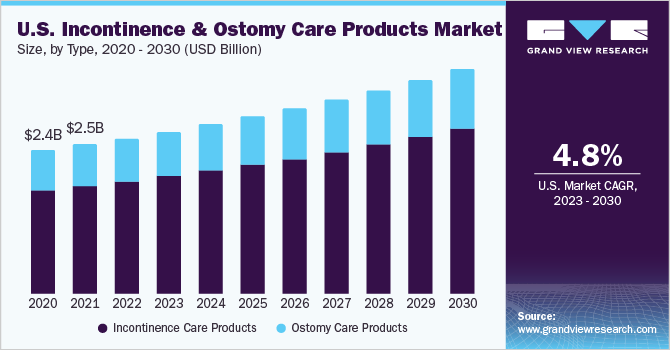
U.S. incontinence & ostomy care products market size, by type, 2016 - 2028 (USD Million) 

The growing risk of colorectal and urinary bladder cancer has increased the demand for ostomy care products. Increasing awareness initiatives by several market players to raise cognizance regarding these prosthetic medical devices globally is successfully breaking the stigma and taboo associated with the use of these products. For instance, Coloplast is a leading market player and has recently published Ostomy Life Study Review to raise awareness and improve the standard of ostomy care. This helps in effective patient care, building their confidence, and inspires them to live a quality life.

Moreover, the outbreak of COVID-19 has spurred the demand for incontinence products used in home settings. Since the majority of consumers are aged/seniors, there is a higher demand for these products. Restrictions on movement at international borders have created an opportunity for local players to enter the market and meet the unmet demands of the end-users. In November 2020, NorthShore Care Supply announced a free trial of 2 bags of adult diapers and a discount on all absorbents for ICU Nurses or other COVID first responders.

Incontinence and Ostomy Care Products Market Segmentation

Grand View Research has segmented the global incontinence and ostomy care products market on the basis of type and region:

Based on the Type Insights, the market is segmented into Incontinence Care Products and Ostomy Care Products.

  • The adsorbents segment dominated the market for incontinence and ostomy care products and accounted for a revenue share of 74.9% in 2020.
  • The segment is expected to expand at the highest CAGR of 5.5% from 2021 to 2028. This is owing to high usage rates and the rising popularity of disposable adult diapers, as well as the growing geriatric population and increasing prevalence of bladder-related conditions.
  • Moreover, the introduction of innovative and personalized products targeting the achievement of user-friendliness and comfort and the gradual de-stigmatization of products such as adult diapers are some of the factors justifying the growth of the segment over the forecast period.
  • Whereas, the ostomy care segment covers a wide range of products, such as ostomy bags, deodorants, skin barriers, and irrigation products.
  • Ostomy bags dominated the ostomy care products segment with a revenue share of over 24.7% in 2020.
  • This segment is also expected to grow at the fastest rate during the forecast period on account of the high prevalence of diseases such as Crohn's disease, colorectal cancer, and Inflammatory Bowel Disease (IBD), a high number of colostomy surgeries, and rising patient awareness levels.
  • Also, the introduction of user-friendly and skin-friendly ostomy bags is expected to drive the growth of the market for incontinence and ostomy care products.

Incontinence & Ostomy Care Products Regional Outlook

  • North America
  • Europe
  • Asia Pacific
  • Latin America
  • Middle East & Africa (MEA)

Key Companies Profile & Market Share Insights

The key players are focused on launching new types of ostomy and incontinence care products and accessories, technological advancements, and growth strategies, such as mergers and acquisitions. For instance, in June 2020, B. Braun Melsungen AG launched virtual support services (Emerald Nursing Service) during the COVID-19 crisis to help weak patients at home with acute bladder problems. This service delivers incontinence and ostomy care products to patients at home by providing facetime video tutorials and advice on usage.

Moreover, major players are adopting various strategies to gain higher market share such as new product launches, mergers and acquisitions, and geographic expansion. For instance, in April 2020, Essity acquired Novioscan—a Dutch-based company that designs and manufactures wearable ultrasound technology—for approximately USD 8.0 million in cash. This device helps monitor the bladder and enables continence control. Thus, such developments are expected to significantly influence market growth over the forecast period.

Some of the prominent players in the incontinence and ostomy care products market include:

  • Coloplast Corp.
  • Essity (Svenska Cellulosa Aktiebolaget)
  • KCWW (Kimberly-Clark Corporation)
  • Braun Melsungen AG
  • Hollister Incorporated
  • Unicharm Corporation
  • ConvaTec Group Plc
  • Welland Medical Ltd.
  • Domtar Corporation
  • Salts Healthcare Ltd.

Order a free sample PDF of the Incontinence & Ostomy Care Products Market Intelligence Study, published by Grand View Research.

Urban Growth and Electricity Demand Expand the Footprint of the Protective Relay Market

Protective relays rarely make headlines, but power systems depend on them. They detect faults, isolate the affected section in milliseconds,...